
The Big Dig Day Two
Day 2 of the Big Dig in mid-afternoon. With over 40 people here, the hole is nearly 5 feet deep at the deepest corner.

The Big Dig Day Two
Day 2 of the Big Dig in mid-afternoon. With over 40 people here, the hole is nearly 5 feet deep at the deepest corner.
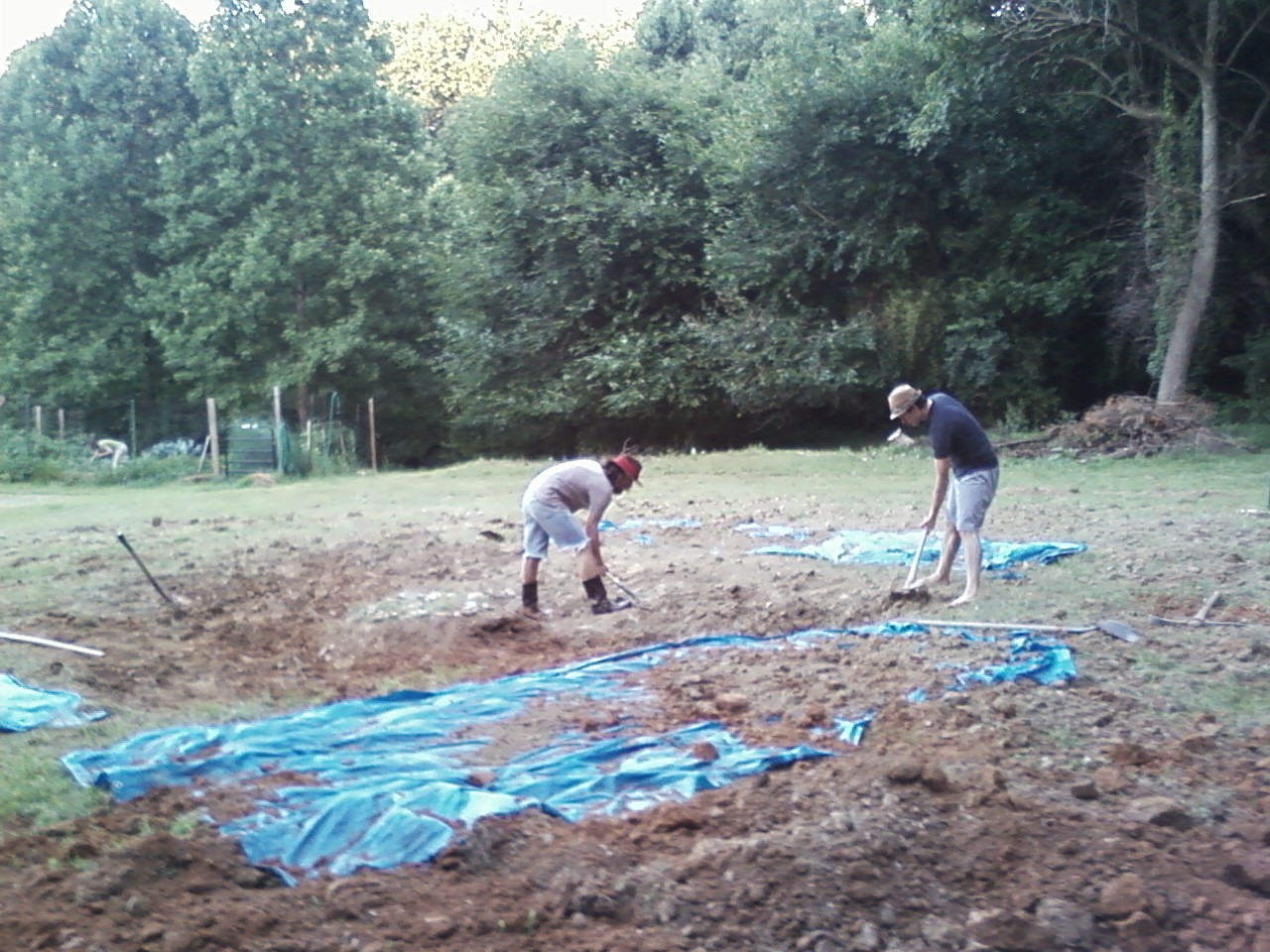
The Big Dig Day One
Today is the first day of "The Big Dig". It should be a lot of fun. Nick and Jeff are working now.
I'd love to support the bands and music of Party in the Park but once again, the City of Rochester has made it for cars-only. Yeah, I know, that's "not what they mean," but when the the press release reads, "for the comfort and safety of everyone, patrons are also asked to leave their bicycles, skateboards, in-line skates and pets at home," just what is that supposed to mean exactly? Bring your nice safe car? They even go on to describe ample parking, but never mention pedestrian access — can we walk along the river path, or is it accessible from the sidewalk only?
And once again, they say, "Patrons may not bring food or beverages (with the exception of one sealed bottle of water) into the concerts." This is because they know they want to encourage people to buy beverages from the vendors, and by making artificial scarcity, they can make more money which is what this is all about. But more sinister is that it encourages people to rely on bottled water. That way, when hydrofracking companies pollute our water supplies, people will already be accustomed to drinking bottled water and not care. Folks already believe marketing hype from bottled water and water-filter companies and no longer believe that tap water is the safest drinking water in the world (it's held to far higher standards than bottled water or other soft drinks).
Ok, I'm done ranting for now … enjoy yer day.
As one who detests hypocrisy, I can't help but be angered by the simultaneous belief that all human beings are valuable, yet it is the dollars they earn that defines their value in society.
There is a widely spoken belief that all people are valuable. For instance, you can't run down a person with your car whether he's rich or poor. And helping strangers is generally seen as good, and hurting them bad.
Yet when it comes to the policies we make to guide our actions, it's a different story. If you have too little money, you don't deserve comforts, health care, a place to live, clothing, food, or even water. In fact, you can be so poor that you are not permitted to simply exist: you must pay for the land you stand upon, or pay whoever owns it to exist there.
So simultaneous with the spoken belief that people are valuable is the belief that existing without working for money makes you a drain on society — that society would be better if you did not exist. This belief has been with us for generations and it is nearly impossible to imagine an alternative. I mean, consider how birds eat berries for a lifetime, but a human is not afforded the same right: the human must work for money to buy berries.
There has been a progression which started with centralized currency (or before), and ratcheted up with the Industrial Revolution. It was then that people became interchangeable parts to a system. And more importantly, that they could be sorted and ranked in value as to the supply and demand of their particular skills. Profit-centric farming is another ratcheting step although subtler: farmers are taught to think of their animals not as living things but as "product". From there we have companies who teach their managers that people are not humans with lives and value, but as "human resources" — conceptually equivalent to a vehicle or a bolt.
I think it's time we formalize this and dispense with the hypocrisy. Rather than having an outmoded caste system that permitted individual merit within a caste, we should simply rank people based on dollars. Each persons lifetime earnings will be extrapolated linearly to their expected lifespan. That is the worth of a person. An alternative but equivalent comparison can be made with jeir average dollar-per-hour rate.
For instance, Warren Buffet's net worth in 2008 was $62 billion (according to a quick check of Wikipedia), so on average over his lifetime, he earned about 2 million dollars a day or about $90,000/hour. Compare that, say, to someone earning minimum wage in New York ($7.25/hour), 40 hour weeks, from age 18 to 65 — a lifetime total of $700,000. Basically, then, if a minimum-wage earner were to detain Warren Buffet for 8 hours (whether deliberately or not), Warren Buffet could kill them and it would be considered fair because the equivalent monetary damage was done — after all, there would be no way for the minimum-wage earner to repay Buffet's loss.
And what of the confusion in making things safer? If an airline can prevent one additional crash at a cost of, say, $10 million, is it worth it? With this system, the airline can examine the expected total earnings of each passenger, and tally for each flight. If the worth exceeds the cost of the upgrade, it can be considered a good investment.
In the end, we can simplify everything in life by moving to a true dollar-based morality. It's clear that it is desirable — I mean, if human lives were valuable, we would have universal health care just like every other first-world country, yet we have constant debate that it will be used too much by poor people. The same goes for social services and even immigration. If we valued human beings as human beings, any person living in the boundaries of the U.S. of A. would be afforded the same rights and responsibilities, yet we cling to a nationalist system to ensure that some people are as valuable as unwanted insects.
So spread the word and calculate your own worth so you can know whether you're better than your neighbor. What a wonderful world this will make!
A friend of mine invited me to an event called the "Instant Album Party", now in its second year. The gist is that they set up a practice space and a recording studio with their own and borrowed instruments and gear, and then spend a day record an album of songs, each created in 1 hour by randomly-selected people in heretofore new bands.
At first I thought I'd go to spectate, but I couldn't resist throwing my name in. I played trumpet when I was in grade school, have feebly attempted to teach myself slide guitar, and took a few months of singing lessons ten years ago. I've never been in a band or performed a whole song, save for some drunken karaoke nights. Basically no musical experience at all. So why not join a band?
I stopped in briefly at the very beginning of the party around 10:30 a.m. to drop off some audio equipment in case they needed it, and I put my name in the festive Christmas tin and tossed a couple fictional band names in the unfestive water jug. I returned at 3 p.m. and things were starting to really take off. The first band was drawn at 11:30 a.m. and at 1-hour intervals from there on. My caffeine buzz was starting to wear thin by the time my name got picked at 9:30 p.m.
So five of us guys (who for the most part had never met one another) are a band. We got four choices from the band-names bin and decided the best of them was "Brochures!". We headed to the basement Kenny played keyboards, Ben (or Ian) played drums with Justin backing up on both a tomtom and with vocals, and Ian (or Ben) played electric guitar.
While the other guys hashed out some melodies, I started scribbling furiously to try and come up with some lyrics. Earlier in the day, someone was telling a story that happened a short time after breaking up with his girlfriend, except he used the phrase "brokeing up" by accident. I commented that "brokeing up" really captures that initial feeling where present-tense and past-tense collide, and I decided to try and work that into the song. Aside from that, I just listened to the style of music and wrote down a bunch of lines. Within 10 minutes or so the words started to congeal into a simple 3-verse structure with a chorus.
I shared my ideas and did my best to match a melody to the music already created, singing my best on the microphone. We hashed through it a couple times and (owing largely to my lack of musical and band-performing skills) I had a hard time figuring out exactly when to sing. But it wasn't long before the hour was up and we headed to the recording studio.
Making it more difficult for recording was that I had to sing once for the band's sake, then again listening to the recording, and I just couldn't remember exactly how I did it the first time. Nonetheless, things sounded pretty good and Justin added a harmony to the chorus in a subsequent track. We finished at 11:29 p.m.
We got to name our song, and picking from the lyrics, we all agreed "There is no July" was the way to go. Presumably they'll put the new album on the same Shark Tank Shows BandCamp.com where the 2010 album is available for download.
Anyway, it had dawned on me earlier that day that I finally had an answer to a question from my own (and something similar from anyone's) past: "how do I meet women?" Of course, in my case, if I were asked "well, why don't you?", I'd say I was afraid of the unknowable. So one of the big things to do, I think, is to practice boldly entering the unknowable future. That is — along the lines of fear and excitement like I've talked about before — making a habit of seeing new opportunities as something to excitedly experience rather than something to fear failing at. If I had lived like that at age 25, I'd probably be a few years "ahead" of where I am now. But no matter because every time I remind myself to push myself, the more of a habit it forms, and the better things get.
I figured it would be interesting, so I headed over to The Flying Squirrel Community Space (285 Clarissa St., formerly the Flower City Elks Lodge) to see the essay film END: CIV Resist or Die. Filmmaker Franklin Lopez introduced the film by talking about how he was deeply moved when he heard Derrick Jensen speak and how he built his film around much of Jensen's work. Lopez said he was impressed by the impeccable logic laid out in Jensen's books Endgame, Vol. 1: The Problem of Civilization, and Endgame, Vol. 2: Resistance, which outline the environmental apocalypse in our midst as simply being caused by what we call "civilization". I'll narrow things a bit and discuss corporations and industry.
First, note that corporations, organizations, machines, and tools, if anthropomorphized, are psychopathic. In other words, these things behave without consciousness, hence without inherent morality. I know that corporations and organizations include people which do have morality, but the nature of the group does not reflect that individuality. In fact, because corporations and organizations have rules in place that prevent any one person from having any decision-making power, the effect of their individual morality is nullified.
Second, all corporations we create have as their highest priority (or if not, a high priority) to make money. The secondary priority of a corporation is to operate in its industry sector. There is no primary consideration to the value of human life, or of life in general, or of the resources life needs to survive. As such, if life-giving resources, life, and human life are an obstacle to those goals, the corporation will attempt to spend as little money as necessary to get past those "obstacles."
Third, corporations generally do not have an expiration condition. As such, they will continue to operate in the primary industry sector until there is no economically viable way to continue.
Finally, the economic and social system we have in place is generally taken as given. That is, what we call "civilization" cannot be changed directly.
The film looks closely at two industries: oil production and logging.
In the case of the logging industry, the cheapest path to financial success is greenwashing — giving the illusion of sustainability — as that is cheaper than actual responsible forestry. In one instance, a tribe of Native Americans attempted to stop a logging company from cutting down the forest on their sacred lands, but Greenpeace intervened and came to an agreement to permit logging of their lands. (Yes, you read that correctly: Greenpeace voluntarily did not stop the logging.)
More damning, though, is the case of oil production. The industry likes to claim there are nearly limitless reserves available. What they fail to mention is that unlike when oil was discovered bubbling out of the ground, the extraction of newly discovered oil is nearly a losing battle. In fact, if they were charged for the water destruction and the pollution from leaks and accidents, it would likely not be profitable. But the industry subsidizes itself by coercing agreements to use and pollute water without added cost — destroying the resources necessary for life in its driving need for further profitability.
The film refers again to Jensen's works to note that peaceful protests were coincident with violent ones. In other words, Mahatma Gandhi and Dr. Martin Luther King, Jr. did not act in isolation — rather, they were the peaceful resisters in a sea of varying degrees of civil disobedience, property destruction, and bloodshed. As such, the power structures in place were able to engage them and make some advantageous changes, but only so much as to defuse their more violent contemporaries.
It's clear that peaceful protest alone accomplishes nothing. I have watched as wars were started with 250,000 people in the streets of Washington, D.C. in opposition. And I now see how natural gas companies are running roughshod over the peaceful protest of citizens only wishing to protect their water supplies from contamination. Without the teeth of violence, no change occurs, even if it is not those acting in violence who sit at the negotiating table in the end.
Derrick Jensen has an interesting quote about all this from Endgame, Volume 1. He opens by asking if the reader would have joined the resistance in Nazi Germany then says:
Now, would you resist if the fascists irradiated the countryside, poisoned food supplies, made rivers unfit for swimming (and so filthy you wouldn't even dream of drinking from them anymore)? What if they did this because … Hell, I can't finish that sentence because no matter how I try I can't come up with a motivation good enough even for fascists to irradiate and toxify the landscape and water supplies. If fascists systematically deforested the continent would you join an underground army of resistance, head to the forests, and from there to boardrooms and to the halls of the Reichstag to pick off the occupying deforesters and most especially those who give them their marching orders?
When, exactly, is enough?
For the past three weeks or so, people have been meeting at The Flying Squirrel Community Space (285 Clarissa St., formerly the Flower City Elks Lodge) to discuss anarchism. Having not attended the earlier meetings, I can't really tell what constitutes anarchism (e.g. self-rule? using the self-organizing facet of humanity? not having a government?) but I couldn't help but attend the seemingly unusual topic of "Anarchism Against Racism, Sexism, and Homophobia".
I'd say there were about 15 people there, and most of them had attended the other meetings and read the associated articles — it's something of a free-school model. I think everyone expected a more lively discussion because the topics were so emotionally-charged, but the ground we covered between was fruitful and interesting.
In short, Capitalism depends on exploiting value to gain more than is spent. Through that, it seems to demand an underclass: a group of people who are considered lesser and therefore are free to be exploited. (In fact, the only way great wealth and power is achieved is by exploiting others.) And the way to identify the underclass is to tie the "underclass-ness" to a defining characteristic: woman, gay, black, Irish.
Anarchism, by eliminating the presumption of authority, denies the creation of an underclass. In other words, anarchism (when considered "self-defined rule") does not permit the creation of people having authority: it is up to each individual to grant that authority. So there is no way for an authority to declare that you are X and therefore shall be exploited; rather, you as an individual would have to grant an authority that power, and permit yourself to be exploited. Presumably you would never volunteer for that.
The trouble is that the system I live with (that is, in America) will always find a new underclass to exploit. Lately it seems Hispanic people and followers of Islam are the newest targets (not that they were ever considered equals). Although we have also exploited the Chinese in their own land to that end, and I suspect the next source of cheap labor will be on the African continent. I find it a distasteful cycle that I'd like to see end sooner than later.
A few months ago I attended a film screening sponsored by Restorative Rochester. Since then I signed up on their Yahoo! Group and have been lurking for a while. The group's goals revolve around "restorative justice" which — as I understand it — involves bringing victim and perpetrator together to find a sense of closure. The U.S. legal system is a correctional and punitive system that seeks to find a way to punish a perpetrator in a manner proportional to their crime — yet it ignores the wishes of victims in its rigidity.
Last week I decided to introduce myself to the group. I mentioned that I wanted to refrain from contributing in conversation as I want to try and give my legal-system thinking time to adapt to the possibilities of something else. In other words, I'd probably ask the same questions as anyone, starting with, "if you offer an alternative to punishment, won't that give criminals free reign?"
Anyway, lurking lasted all of a half a day. Kit Miller sent out an message that they were looking for additional people to join the group for a dinner with Jennifer Thompson-Cannino, and Ronald Cotton, co-authors of Picking Cotton at The Asbury First United Methodist Church (1050 East Ave.) I had intended to go to the lecture and discussion anyway, so I immediately agreed.
Ronald and Jennifer have the most awkward answer to "so how did you two meet?" In 1984 Jennifer was raped in her apartment. She had the presence of mind to study her attacker and memorized his face. Through the course of the investigation, the closest match was Ronald Cotton, and she confidently believed he was her attacker. He went to prison for 11 years until he was granted permission to have the DNA evidence tested and, as he had claimed all along, he was not the man who raped her. Eventually Jennifer sought to meet Ronald to resolve her fear that he was steeped in resentment toward her. As it turned out, she was mistaken, and they became friends as both were victims of the actual perpetrator who was later convicted of Jennifer's rape and six others after hers.
The first time I heard their story, I thought, "that's wonderful" (albeit in a heavily qualified way). A more common reaction is to be incredulous that there can be any healing and forgiveness. But what alternative to forgiveness is there? And in this case, it was neither Jennifer's nor Ronald's fault, so it seems obvious to me. I don't mean that I'm holier-than-thou, but even when I'm angry at a transgression against me, I cool very quickly and generally conclude that staying angry — or generally believing in the winner/loser model — offers less value than forgiveness and resolution. That said, I'm less amenable when the other party stays remorseless and confrontational. Thankfully that's usually not the case, especially when I can genuinely offer a solution through forgiveness.
The things that resonated most with me were about the ways our justice system failed. Racism and prejudice aside (not from Jennifer or Ronald, by the way), I was once again jarred by the unreliability of eye-witness evidence, I reinforced my opposition to the death penalty, and I am saddened that people justify the bad things they do by believing that they have some kind of credit for being a "good person".
On prejudice, I'll just note that the police, after hearing Jennifer's description and seeing her composite sketch, probably swayed the whole case by presenting Jennifer a 3-year-old photo of Ronald that better matched her description.
Having watched things like The Selective Attention Test, I'm amazed at how bad my perception really is. Like everyone, I live every day with the persistent, tenacious illusion that what I perceive is a perfect reflection of reality. Yet when I'm presented with something like that video, I'm always astonished. I keep that knowledge close at hand, however, and even if I fully believe in my perception, I deliberately apply uncertainty to the way I express my perception to others. Yet nobody teaches us that fact — that our perception is lackluster — so our justice system is still rooted in an ancient belief that an eye-witness is proof-positive. Thankfully, I think this is changing (even lawyers who claim this is true are not considered as deceitful as they once were).
Relatedly, would this not be the kind of case that warranted the death penalty? What if the real rapist had gone on to kill his other victims — and Jennifer was the only one who survived? It is far too big a risk to potentially kill an innocent person. In addition, they had mentioned in the talk that the DNA evidence from the case was slated to be destroyed 3 days before Ronald requested the test, so had the justice system acted at its normal geologically-scaled rate, Ronald would still be in prison, and all the good that happened wouldn't have.
And finally, my favorite topic: religion bashing.
Ok, actually it's only tangentially related. The fundamental problem is believing in the possibility that a person can be good or bad. It's as illogical as claiming a glass of water is happy or sad: it is not the kind of assessment that makes sense. Only individual actions, taken in isolation, can be considered good or bad. And even then, the moral judgement is largely based on the observer.
The trouble in this misattribution is that belief in morality within a person dilutes the perception of morality in their actions. And I'm talking about belief in the self: if I believe I'm a good person, then any action I do must necessarily be good (or at least better than a bad person who does the same thing). Likewise, if I think I'm a bad person, then it's in my nature to do something bad.
So how does this relate to religion bashing? Well Jennifer mentioned that when she doubted herself — when she doubted her actions were the most right thing to do — she remembered her religious upbringing and reinforced her belief in her inherent goodness, ergo the goodness of her actions. I think that the failing of religions is teaching "you are a good person". As I said, the nature of that statement is in error.
A better teaching would be that your past does not dictate your behavior — that there is not inherent good or bad in people, but that whatever you do or don't will benefit some and harm others. I get stuck at this point because no guideline is adequate. Everyone desires to do good (that is, for ones actions to have beneficial consequences): it's at the heart of what lets us as individuals and us as a society survive. Any attempt to codify that dilutes what it is to be human.
About this time last Thursday, I was arriving in Boston. As an actor in The Beast Pageant, I was tagging along with filmmaker Albert and costume designer Vanessa to The Boston Underground Film Festival (BUFF). The Beast Pageant's artistic dream-logic metaphor was just barely appropriate for the horror-and-gore territory covered by the festival.
The opening-night screening was Hobo With a Shotgun at The Kendall Square Cinema (1 Kendall Sq., Cambridge, MA) — where all the rest of the films would be screened. I found "Hobo" fantastic — a 1980's action-exploitation film with Rutger Hauer, no less, in the lead role as a hobo trying to make ends meet but cornered into violent action. The bad guys are played with comic-absurd gusto as all parties are supported by a tongue-in-cheek script.
Afterward, that night's part was at T.T. the Bear's Place (10 Brookline Pl., Cambridge, MA), right around the corner from Middle East Restaurant and Nightclub (472 Massachusetts Ave., Cambridge, MA). There were several bands and The Whore Church was performing live video mixing. Unfortunately it wasn't much of a place to chat (nor was there food) so we went to the Middle East for dinner which was pretty good. We weren't particularly impressed by T.T.'s as service was blasé and drinks were expensive ($2.50 for a soda, really? — but I guess that's Boston for you.) We got the last train on the Red Line to get home around 12:15 a.m.
On Friday we headed to The Gallery Diner (11 P St., South Boston, MA) which was fantastic. We made smalltalk with the friendly owners Paul and Colleen and the food was great. Exploring the Harvard Square area, we stopped at a few record and comic stores and I got an excellent fresh, locally-produced shake at the regional fast-food chain b.good (24 Dunster St., Cambridge, MA).
I checked out the "BUFF Family Values" short film program back at the festival and was pleased with all the films — some disturbing, some powerful, some funny, and some just strange. Later that night, we all saw Machete Maidens Unleashed which was a pretty decent documentary about the Philippine exploitation film industry in the 1970's and 1980's. I opted to see the 1973 film The Twilight People which was made in the Philippines during that era — a terrible film by nearly all counts. I recall listening to the dialog and thinking, "I wish they'd stop talking" and a scene later when they were walking through the jungle, "I wish there was more dialog". It was astounding to me that someone put this film together and decided they were done — continuity, plot, editing, and special effects came second to, well, cost, I guess.
Saturday started with an acceptable breakfast at Mul's Diner (75 W. Broadway, South Boston, MA). From there we went straight to the festival to catch "OMFG LMFAO!" and "Psychedelicinema" — a pair of shorts programs. The first offered a few chuckles but we didn't find it all that funny. The second was, in my opinion, a little better, but it was really abstract films and not psychedelic. We stayed for about half the program, skipping out partway through the 30-minute final film.
Between screenings I met Josh MacDonald, writer of The Corridor. I skipped the "Where the Music's At" music-videos short program, to see Josh's film. It was really excellent: evenly paced and gradually asking for suspended disbelief at the increasingly paranormal activity ensuing on screen. Despite its evenness, it delves into some extremely dark and gruesome territory — I found it highly successful.
We had a break and got to hang out (finally!) with other filmmakers at The Friendly Toast (1 Kendall Sq., Cambridge, MA) — and the only event to include free food. [I realize I'm knocking the festival for lackluster treatment of out-of-town guests, but I also know they're running on a shoestring budget and just didn't plan things out very well for us.] We finished the day with a pleasant at-home dinner with friends and family.
Sunday I met with my college friends at The Daily Catch (441 Harvard St., Brookline, MA). In 2002 I went to The Daily Catch (323 Hanover St., Boston, MA) and loved it, so I had to go back. The location in Brookline is bigger so Jan, Griffin, John, Michelle, Rob, Kevin, and myself could comfortably fit. Unfortunately they didn't open until 2 so we dawdled on the street, hanging out at the super cool Irving's Toy and Card Shop (371 Harvard St., Brookline, MA). At lunch I had the pistacio-encrusted swordfish which was fantastic. Everyone had a good meal for sure. We stayed and talked for a couple hours then Kevin and I headed back to the festival.
We got there a bit early and had plenty of time to get into the big event (for us): the screening of The Beast Pageant (and on IMDb). About 40 people showed up to watch it and, as best I can tell, really enjoyed it. It was fun to be part of the question-and-answer panel.
Afterward was the closing night party at Tommy Doyle's Irish Pub and Restaurant (1 Kendall Sq., Cambridge, MA). (The festival runs once during the weekend, and then nearly all the films are repeated during the week, making it possible to actually see every screening.) I had a celebratory shot of 18-year-old Glenlivet scotch — my first alcoholic drink since the beginning of December when I quit (I permit myself a rare taste of something extraordinary, or under truly extraordinary circumstances.) The Beast Pageant won a runner-up "Director's Choice" award for best feature.
On Monday things got amusing. We got up for breakfast and I headed out around 11:05 to get the train back home. We had been averaging 15 minutes to get to the South Station where I was to get the train, but today buses were running on a half-hour schedule rather than every 10 minutes. I called for a taxi around 11:30 and was promised one immediately; I passed on boarding a bus that arrived shortly after. Alas, the cab didn't show up in time. I took the next bus and got to the Amtrak station (Summer St. and Atlantic Ave., Boston, MA) about 20 minutes late — if only I'd have hopped on that 11:30 bus. Alas, I traded my unclaimed ticket for one tomorrow. At least I got to see "Future Imperfect" — the science fiction short film program. It was okay but not great. Kevin was kind enough to let me stay at his place.
That night he and I went out and got dinner at Punjab Palace (109 Brighton Ave., Allston, MA) which really had great Indian cuisine. After that we went to see bands play at Charlie's Kitchen (10 Elliot St., Cambridge, MA). We were disappointed in the first act and headed to The Lizard Lounge (1667 Massachusetts Ave., Cambridge, MA) for an open-mic. That was a blast and we stayed quite late. We got back to his house and I slept on the futon couch.
I left when Kevin went to work, taking the T into the city packed with all the commuters. I found the Banksy graffiti art that Kevin mentioned off Essex Street then went to The South Street Diner (178 Kneeland St., Boston, MA) for breakfast. The staff was friendly and the breakfast burrito was quite good. I hung around and chatted for quite some time, arriving at the train station with plenty of time to spare.
I was happy to be on the train home. I arrived in Albany a little late but had about an hour before it left again, so my parents stopped by and we had a quick and decent Italian dinner at (if I remember right) Rudy's V & R Ristorante (483 Broadway, Rensselaer) across the tracks from the station. I was worried for a bit but got back in time to get back on the train home.
On Tuesday, March 29, the City of Rochester will hold a special election for interim mayor. Although the election defies the City Charter (which directly specifies that the Council appoint an interim mayor), it appears that the election will take place and the results of that election will be supported over the Council's transgression — at least until the next election cycle.
On the ballot are Alex White, Bill Johnson, and Tom Richards along with an active write-in candidate Ann C. Lewis. I wrote about the candidates at the Gleason Works debate, and had a chance to hear them discuss issues on March 14 at St. Anne Church (1600 Mt. Hope Ave.) where they reinforced my original report. As I see it, there are several challenges the City of Rochester faces that the mayor should be addressing.
First, the City needs to innovate to survive. While it is important to examine other cities' successes, copying those plans simply sets us back at least a couple (if not ten) years, for those cities plans germinated long ago. We need a mayor who knows Rochester and how to leverage its strengths and repair its weaknesses. We also need to examine the reality of the coming major economic disruptions: ever-increasing fuel costs and the related dwindling supply, changes in the balance of power in global economics, and environmental attacks on our generous and clean water supply.
Next, the City also needs to abandon the harmful practices of the past. First is to stop using public money for private projects, avoid the ulterior motives of developers' "suggestions", and (as I explained earlier) to stop affecting the assessment of business risk (that is, to stop paying for part of a private project to "sweeten the deal" for a potential business). Nearly all of the past boondoggles could have been avoided by following those practices. Second is to equalize the tax base so small businesses can compete with big ones: as it stands now, big businesses are strongly favored for tax breaks and public money leading to a proliferation of unsustainable monoliths (that is, unsustainable if they had to pay full taxes like small businesses do).
Finally, the City must address the crippling poverty. This is the cause of numerous problems in Rochester, including the troubled school system. Poor planning on the City's part to mitigate it has resulted in an explosion of police presence — a desperate last-ditch effort to effectively imprison the "problem".
Alex White is a small business owner with tremendous skills in long-term strategic analysis. He has demonstrated that he understands all these problems, has directly acknowledged them, and has provided potential solutions. His innovative solutions are rooted in modest changes on the governmental front (such as more flexible zoning), proper public-works projects (such as inexpensive electricity through a municipal power company), forward thinking (such as making the city more walkable to phase-out the need for constant car use), and using regional resources to our advantage (providing support for college graduates to innovate with new, in-city small businesses). He is not foolhardy with money and has short-term plans to patch budget shortfalls while understanding that it is necessary and efficient for the city to collect taxes and provide certain kinds of services. He is the best candidate for mayour.