Watching Le quattro volte at the Dryden

I was very impressed with Le quattro volte (The Four Times) when I got a chance to see it at the Dryden Theater at George Eastman House (900 East Ave.) It feels like a documentary but is actually a story as seen from the perspective of God, or the natural world, or the land rather than from an omniscient observer tending to a particular character or traditional story arc. It reminded me a bit of Bu san (Good Bye Dragon Inn) with its unusual narrator (in that case, the aging theater itself).

The film starts by following an old goat herder through his simple life. Like I say, it looks like a documentary, although I noticed a few little cinematic-style errors creep in, and (through the introduction) I already knew it was a narrative.

But you know, this isn't really the way to talk about the film. The mechanics of how it works aren't of much importance. It's a film about feeling, and about the broad strokes of reality. It'd be like trying to describe clouds by talking about evaporation.

It's got a refreshing way of using motion picture like a moving photograph. It's a snapshot of things as they are, and the nature of how "the way things are" is nonsensical since things are always changing. Life is change, death is change. And through this (pardon the apparently unavoidable cinematic metaphors) moving image — this lens into a world of our own from a vantage point seldom seen — we get hope, sadness, contemplation, and mirth all bundled untidily as life does.

Seeing Red Desert at the Dryden

I was feeling a bit depressed but I wanted to see Il deserto rosso (Red Desert) anyway so I walked out to George Eastman House (900 East Ave.)

The movie was extremely impressive. From the introduction, I gathered it was not intended so much as a condemnation of industrialized society, but rather a portrait of its beauty. It does so, however, by showing industrialization as boldly and plainly as possible. The protagonist — the wife of a high-level manager at a chemical plant — is set against this landscape as a way to demonstrate it. Her world is shifting beneath her, but the hard gray of industrialization stands sturdily.

I think most people naturally gravitate to her plight, and as such, see it as a rather bleak movie. Given my mood at the outset, I was ready to let it all wash over me in that way. But I also understand that the industrialized facets were just as central — and if you can believe that the man-made structures are the protagonist, the whole thing seems pretty uplifting.

When I left, I decided to just walk straight home. I was still in a funk, but was also affected by the film. I kept looking at the world in odd ways — looking at things that I would ordinarily ignore.

My mood got particularly bleak when I (walking home alone once again … as usual) decided that this was all there was; that my best years were behind me and solitude and ever-weighing loneliness was all I had to look forward to. From here on out, there would be no surprises and I'd just trudge through day-by-day, step-by-step.

All of a sudden, a cat raced past me, startling me. It ran ahead of me and plopped on the ground begging to be petted. I declined its advances, but it reminded me things aren't always the same.

Attending TEDx Rochester 2011

Today was the third year of TEDx Rochester, held at Geva (75 Woodbury Blvd.) TED is a lecture series that originally focused on "technology, entertainment, and design" (providing the words for the acronym) but shifted to simply, "ideas worth spreading". "TEDx" lectures are independently produced, but attempt to mimic that theme. This year, TEDx Rochester featured sixteen live discussions, two video presentations, and a proper video lecture from TED itself.

Adam Walker kicked things off talking about a project he's involved with: The Kosovo Wind Gardens. The idea is to create small electricity-producing windmills all around countries without infrastructure for a reliable electric grid. Kosovo is one example, as it has very few power plants (their largest is a 1950-designed coal-burner with disastrous emissions) and simple things like dairy milk production are hampered by unreliable power. The windmills are designed with "appropriate technology" in mind: not just something from an industrialized nation, but a design that relies on simple materials and manual labor (rather than efficiency of mass-production) to better suit local self-sustainability. I was impressed with Walker's presentation and the keen sense of appropriateness and a focus on the people being assisted.

Next was Andrew Perry who discussed Visual Literacy and Graphic Narratives. His thesis was an attempt to show that the means of storytelling and communication are changing — whereas the poem was central to literature prior to the 16th century the novel became the dominant form starting around then, and now we are seeing a new form that integrates text with images and diagrams (in a creative, literary way, not solely for factual reference). There is a new manner of storytelling that goes with it and, while I'm not sure it will become a dominant form, it has definitely come into its own as a rich and complex literary form.

Ashley Aberg then spoke about the difficulties of changing medical thinking when it comes to gender. She centered her talk on what medicine calls "intersex" — neither dominantly male nor female. It is because the male/female binary-gender system influenced the medical community that the medical community considers it worthy of "correction" that typically involves surgically modifying the appearance of a child's genitals. Aberg's point is that there is nothing life-threatening or unnatural about intersex, and as such, it is society that should adapt to it. In some ways a radical concept, but in others, it is solely habit that keeps society's view of gender from matching what nature produces.

Next, Christopher Azzarra spoke about Improvisation: Musical Literacy Beyond the Page. As a music teacher, he observed that formal musical training does more to hamper individual music development than it helps. Since the measurement and analysis of music is so mathematical and sterile, it is hardly the place to start. Instead, he provided some examples of how natural it is for children and for professional improvisational performers to communicate with one another purely with music. Music touches us deeply because it is a fundamental part of our being.

Next was a video presentation of Raymond McCarthy Bergeron's La Lune et Le Coq — an amusing animation wherein the moon and rooster compete at the end of the night.

Dr. Tim R. Mosmann, Ph. D. gave a presentation on the complexity of the immune system. He gave a depth-first tour of immune response and how astonishingly complex it is. At each of a half-dozen levels (from the body to the lymph nodes to the chemistry of the lymph nodes to the cellular interaction to sub-cellular and so on) a huge amount of information is known on how it all works. But then we can extrapolate the exponentially large amount of information, since each specific example was only a fraction of the interaction at that level. In essence, the amount of information is too large to aggregate, so we need new tools to handle it.

In another radical turn, next was Jim Maddison who gave a case for building the The Roc City Skate Park under the eastern terminus of the Freddy-Sue Bridge. Like the shift to accept graphic novels or intersex individuals, skateboarding is a perfectly acceptable leisure activity that offers a mix of exercise, creativity, and accomplishment. Maddison and his team have been working to break down the entrenched view of skateboarders as ne'er-do-wells and hoodlums.

Xanthe Matychak presented Make Better Stuff: the rise of social business and distributed manufacturing. She sees a major shift in manufacturing where it will be possible to build on-demand at nearly anywhere in the world, alleviating the need for the manufacture/transportation cycles we have now. I tend to agree that these new technologies are a game-changing development. But I don't think it will have as nearly a large impact as she thinks or hopes, unless we see a major change in how people view money and cost that would permit local artisans to overshadow the desire for cheap mass-production.

Emcee Howie Jacobson presented his own project: Vote Be Heard. The gist is to encourage primarily poor, primarily black, and primarily inner-city people to vote in major elections to make their world better. Although I think the effort was valiant, it did not strike me that much care was given to the voices in those communities. In other words, it seemed like some comparatively wealthy white people got together and made what they thought would be powerful messages for a group they largely do not interact with. As I see it, the inner-city poor (like the Occupy Wall Street movement) have little idea what they can do to improve their situation without the benevolence of the wealthy people who keep them there. Because of that, voting has comically little effect, and the oppressed are wise enough to know that.

Theresa B. Mazzullo followed that talking about a group she's involved with, $eedNY. They have financial resources to fund start-ups and other technology ventures. I spent her entire talk trying to give her the benefit of the doubt, but I was seething as I wondered why people with great ideas and people with the ability to produce things (and often some of both in one person) were not already rewarded with great wealth — and those who have great wealth have neither ideas nor means? Further, I seethed at the whole "venture capital" concept where a person with an idea presents it to those with money, and if they are given money to proceed, either they fail and the gambled capital is lost (and they probably have to pay off crippling debt regardless) or they succeed and the bulk of the profits go back to the investor, reinforcing the cycle.

In another topical twist, Jon Schull presented a history of transportation, paying particular attention to bicycling and human-powered vehicles. Although his talk was interesting and sometimes enlightening, it lacked a call-to-action punch. Rather, it seemed to advise going along for the ride and to be prepared for things to change in the future. Having lived a zero-automobile lifestyle for 4 months now, I feel deeply relieved that I need not worry about all the maintenance owning an automobile brings. I tend to work from broad goals — even in 1994 when I bought my Civic, I was already thinking about rising gas prices (which never hit until 10 years on), and since then, I tended to steer my life toward eliminating the need for a car. Having finally achieved that, I feel well positioned for the future. I advise people to do the same: it's much easier to plan to live close to work 10 years from now than it is to try and achieve next week, so start now thinking how to adapt to our world in 10 years.

Mark Noble presented some recent developments in stem-cell research. Again, an informative lecture, but pretty much just that. And again, part of me gets annoyed that (in America, at least) this lifesaving technology is reserved for the rich people who can afford it. It's kind of disheartening to know that I'm less valuable as a person than someone else.

Triggering more irritation was Hasan Elahi's video lecture from TED titled Hasan Elahi: FBI, here I am!. In this case, I was annoyed with the totalitarian police state we live in, not in Elahi's lecture. He talked about how he was interrogated by airport security because of a name mix-up and how he now lives his life under constant government scrutiny. His solution was to publish the minutia of his life: he uses his smart-phone to periodically (and frequently) document his whereabouts along with other things like photos of his hotel rooms or the urinals he uses. In the end, it's a clever redirection of energy that is resulting in a surreal art project on surveillance.

Prove Your World was next: a group of people who are working on a science-based program for children that tries to be better than either dry lecturing or vacuous demonstration. By that, they mean that (like Christopher Azzarra said about music) exploring the theoretical side of something first turns people's interest away, yet by simply offering a flashy demonstration without explanation leads to no learning (or, for that matter, curiosity) whatsoever. Their technique is to start from a simple question (in their demonstration it was, "what's a supernova?") and use demonstration as a tool for learning. Of all the lectures, this was the one I want most to get involved with. Of course their pilot episode is about how airplanes fly, and I cringe that they will reinforce the "equal-transit-time myth" of the airfoil.

Jim Gresko and Dave Vogler paired up to talk about how design is similar to jazz improvisation. I thought it was an innovative approach to discuss the concepts and it worked well.

Next was a discussion of Empathy in Education by Timothy Cottrell. He runs a program called The Center for Mindfulness and Empathy Education which pairs high-school students with people in Hospice care. Students' own testimonials revealed a surprising maturity for people in young adulthood.

BELIEVE/Visual Intervention is a film by Ian Wilson and Philip Night that documents a street-art project bringing in international talent side-by-side with Rochester's own on projects on Troup Street and the Union Street railroad bridge near the Public Market.

Relatedly, closing the show was Joan Hildebrand — "the Voice of the Public Market". She had simple, straightforward observations on adapting to change, as she went from a mid-time TV personality to being nearly unknown in this small town, but rather than harp on what she lost, she found new vitality in her work with the Market.

Overall, I found this year's TEDx Rochester to be an even and varied distribution of good discussions. I found it a little heavy on money and products in that many lectures centered on either an existing or future product or project, or gave significant focus to money and profitability. Of course, that may be more my own bias as I tend to seek TED lectures that are more philosophical or human-centered, and tend to ignore those that highlight a new technology or product. I find it a little off-putting, though, that in their re-cap blog post, they note that they "partnered with RIT & U of R to help us recruit new talent for the stage" and add that in the coming year they are "looking to also partner with groups like The Entrepreneurs Network and High Tech Rochester to expand our net." To me this means even more focus on money, product, and project rather than ideas and exploration.

Arrests at Occupy Rochester

I went to the Dryden Theater at George Eastman House (900 East Ave.) to see Made in Dagenham at 8. Before the film, it was announced that people in Washington Square Park (Woodbury Blvd at South Clinton Ave, across from Geva Theatre) protesting as Occupy Rochester would be arrested: Mayor Thomas S. Richards had ordered them out at 10 p.m. Although that news distracted me through the first part of the film, it was nonetheless enjoyable. It reenacts the events surrounding a strike of female auto workers at a British Ford factory in 1968 — their pay was cut when they were reclassified from "semi-skilled" to "unskilled". I gathered the historical accuracy was not perfect but reasonably good, and although the film concludes stating better labor relations, the Dagenham plant closed after the film was made and moved its operations elsewhere.

Although I'd rather have gone to celebrate for Halloween, I headed to Washington Square Park just about 10 p.m. At that point, no police were around — hauntingly, I saw no police on my way there either, and it was the Friday before Halloween Weekend on the busy East End area (in which one would ordinarily observe 2 or 3 parked cruisers). The members of Occupy Rochester were discussing their plan for the evening. They did this with a technique I saw at an anarchy class: whenever anyone wanted to speak, they were added to a "stack" by a moderator, and then allowed in turn to speak to the group. They used a "living microphone" of sorts where when one person spoke, they'd do it in 4-7 word pieces which were then loudly repeated by the group so everyone could hear.

A posting on the statue announced that the park was to be vacated by 10 p.m. The police had notified the group earlier that they would arrive at 11 p.m. The group appointed two laissons to approach the police when they arrived. The laissons were to explain the purpose of the protest, state that it was indeed a protest and a peaceful assembly protected by the Bill of Rights, and to ask that the arresting officers contact their superiors and request that the arrests be cancelled. The crowd was to remain respectfully quiet for the laissons to speak with police. Discussion in the group then revolved around getting arrested, having bail money, pairing up, and finding a small group of people who would remain at the jail until everyone goes home.

Camera crews from TWEAN (Time Warner Entertainment-Advance/Newhouse Partnership) News Channel of Rochester L.L.C d.b.a. YNN and Newport Television LLC, 13WHAM (formerly WOKR ABC) were on hand. The police arrived at 11:15 p.m. and set up a pick-up truck with what appeared to be a Long-Range Acoustic Device (LRAD) along with about 15 cruisers and a few vans. They announced to the crowd that the park was closed from 11 p.m. (maybe it was 10 p.m. … I don't remember off hand) to 5 a.m. (per city ordinance which they identified), anyone remaining in the park would be arrested if they did not leave in 15 minutes, and all remaining personal belongings in the park would be confiscated. (It reminded me of reenactments of witchcraft trials where the accusers attempted to claim the side of right and good with formal language that failed to address the whole situation.) Some people moved to the sidewalk around the park, leaving a crowd of 40 or so in the park proper and another 50 more on the sidewalk. I opted to observe from the other side of South Clinton. There were about 40 uniformed officers including Police Chief James M. Sheppard and a few other high-ranking officers. Police cruisers had blocked South Clinton at 490 and Byron St. as well as Woodbury from South Clinton to South Avenue.

My friend and City Council candidate Alex White was there. I talked with him a bit and he was checking in with the police and observing to ensure things went smoothly and peacefully. He noted that the police were concerned as they were outnumbered and did not want things to turn violent.

At around 10:35 the police announced they would begin making arrests. Police Chief James M. Sheppard personally attended to the first half-dozen arrests. I don't know if the laissons from Occupy Rochester stated their case, but the crowd was quiet, and they were the first two to be arrested. During subsequent arrests, the crowd shouted at the police things like, "you are working class too", and chanted "shame".

The police had two vans they were using to transport one person at a time to jail until the Monroe County Sheriff showed up with a van capable of transporting more people, at which they filled it with 8 or 9 women from the group.

TWEAN (Time Warner Entertainment-Advance/Newhouse Partnership) News Channel of Rochester L.L.C d.b.a. YNN left before the arrests began as the 11 o'clock news had ended. Crews stayed from Newport Television LLC, 13WHAM (formerly WOKR ABC) although their large production van left before midnight.

Around 12:30 a.m. a woman drove the wrong way down South Clinton. When she approached the police barricade, one of the officers approached her and told her she was driving the wrong way and to turn around.

I left around 1 a.m. before all the arrests were completed, although it appeared that only about 10 people remained in the park at that time. As I heard later, 32 people were arrested.

Mayor Thomas S. Richards did not speak with the protesters beforehand and did not arrive to witness the arrests.

To Las Vegas for My Brother's 40th Birthday

Last Friday I headed out on JetBlue on my way to Las Vegas for my brother's 40th birthday. The last time I got on a plane was in October, 2001 for his 30th in Denver, and I've avoided it because of all the security insanity I kept hearing about. I didn't have any trouble, except that I left all kinds of identifying bangles and baubles at home — no LED ring, no Leatherman tool, no fun custom-made electronics of any kind. And I selected JetBlue because I heard they were pretty good. Indeed inflight services were perfectly adequate. They also brag about how much legroom they offer, but coming from riding Amtrak, I could not fathom having any less legroom — presumably my knees would be the backrest for the person in front of me.

I amused myself during the flight by using the in-flight locator channel (on the seat-back video) to identify interstates I had travelled on my way to and from Burning Man, barely able to recognize the moving semis from 7 miles above. Anyway, we did arrive late enough that I missed the Friday night show my brother was attending (for the second time in my life, I was delayed to change a tire on the plane, an occurrence I calculate must happen about 20% of the time.) Nonetheless, I got checked in to The Excalibur Hotel and Casino (3850 Las Vegas Boulevard South, Las Vegas, NV) and settled in. My brother gambles enough that his mLife card (tied to all the MGM properties) gained him free hotel rooms for himself and for me. The room was unfortunately not as luxurious as I had come to expect, but it was nonetheless comfortable (akin to a Holiday Inn room with no coffee maker) and it had an excellent view of the strip. When I got together with him and his friends, we headed out and stopped at Diablo's Mexican Cantina at the Monte Carlo (3770 Las Vegas Boulevard South, Las Vegas, NV) for some drinks and so I could get something to eat. Food cost about twice as much as it does in Rochester, but any at that price was consistently very good, and I stuck to drinking non-alcoholic beer which hovered around $6 with tip per bottle.

Saturday was my brother's birthday and we had sushi for lunch. Three of us did one of the green-screen lipsynch videos at a kiosk which ended up looking quite amusing.  That night we saw Zumanity in The New York New York Hotel and Casino (3790 Las Vegas Boulevard South, Las Vegas, NV) — an adult-themed Cirque du Soleil show. It was fantastic. Although for the most part I was mesmerized by beautiful bodies (mostly exposed if you must ask) performing astounding feats, I was enchanted by the story in the "Tissus" segment with a man swinging on silky ribbons attempting to catch the attention of his muse. At the climax when they both go flying off I inexplicably teared-up, finding the whole thing wonderful.

Once we got done with the show we headed to one of the newest casinos on the strip and selected a place to eat: Scarpetta at The Cosmopolitan (3708 Las Vegas Boulevard South, Las Vegas, NV). As it was very expensive and fancy, I opted to have a dish I didn't recognize: "moist-roasted capretto" described only as "rapini, pancetta & potatoes". For my fellow philistines, it's goat (presumably baby goat, as Google Language Tools kindly translates the phrase "moist-roasted kid") in a zesty sauce not unlike a brown gravy. (It was further refreshing to worry not about bones as I usually do eating such animals at Indian restaurants.)

My brother's and my regular haunt was Dick's Last Resort at the Excalibur (3850 Las Vegas Boulevard South, Las Vegas, NV). They were generally okay, and (as the Excalibur was among the cheapest hotels on the strip) the crowd was plentiful and rowdy. In any case, once it was just my brother and I, we did a tour of the strip, starting at The Wynn Hotel and Casino (3131 Las Vegas Boulevard South, Las Vegas, NV) — an astoundingly decorated place — where we got breakfast at The Pizza Place there. I had an excellent oatmeal (a refreshing change) and my brother had a perfectly prepared egg/bacon/cheese breakfast sandwich on a giant croissant. On our way back, we got to see a short but impressive show of the famous fountains at The Bellagio Hotel and Casino (3600 Las Vegas Blvd South, Las Vegas, NV).

My brother left mid-day on Tuesday, and I was there until late at night for the red-eye back to New York. Although everything we saw and did was flashy and impressive, it was solely done for the love of money. I was pretty okay for the first couple days, but the whole soullessness of it all drove me nearly mad by the middle of Tuesday. I was biding my time trying not to gamble (I lost about $50 in all, so not too bad, I guess) by sitting out in the warm weather and reading Great Expectations (for the first time as an adult not for any school). I talked with this guy for a bit on the street and he claimed to be England's first rapper — one Raymond Witter (also an author on LuLu) and he was one of a few who wasn't outright selling something.

Earlier in the week, I met a woman who seemed friendly enough, but I was led away from her on suspicion that she was actually a prostitute. I didn't believe it, but on the last day, I met another woman at another casino and after a too-brief chat, she offered to "go upstairs". It was so sad to not be able to make any human connection (save for other vacationers and a few chatty bartenders) … except, presumably, for money. The "alluring façade over emptiness" theme is echoed right down to the thin veneer of the Las Vegas strip over a burnt-out city (which I explored a little of on a morning run on Monday) that only supports the constant construction of its appearance and, apparently, the numerous office furniture stores needed to accomplish that end.

The Failure of Capitalism

I keep touching on the subject of political and economic systems and it is constantly a topic of introspection. My prior essay on the topic identified socialism and capitalism and outlined their strengths and weaknesses. One of the questions on the online dating site OKCupid is: "overall, has capitalism made the world a better place?" — yes or no. I went back and forth on my answer and offered the explanation, "umm … yes, weakly. It is ONLY good for fast growth (like building a nation), and once we get to a point that we don't need fast growth, it is very very bad."

But you know, I'm beginning to think it's about as useful as using dynamite to go fishing. Sure it's the fastest way to get all the fish, but aside from that, no good comes from it. So now I declare capitalism a complete failure.

Here's why.

Let's move aside from any system and talk about what kind of standards would define a good system. Kind of like a scientific-ish way of looking at it — to look at how we would measure what makes a great system, or a great society.

My first take would be "everyone is genuinely happy all the time". That's the ideal target which isn't actually possible. So what would be acceptable? I'd lean toward "everyone is genuinely happy most of the time" more than "most people are genuinely happy all the time" — in other words, everyone in the society gets to be happy sometimes is better than some people never get to be happy. I'd further say that it be pretty balanced, so there isn't a group of people who are happy one day a year and another group that are happy 364 days a year.

So what's happy? I'm kind of a fan of Abraham Maslow's "Hierarchy of Needs". I learned about in an intro to psychology class in college and it's always stuck with me. The gist is that each human being must first have jeir "Basic needs or Physiological needs" met before jee can be content in having jeir "Safety Needs: Security, Order, and Stability" met before jeir need for "Love and Belonging" before jeir need for "Esteem" (feeling successful in life to yourself and others), and all that before jeir "Need for Self-actualization".

For reference, I'll quote the Wikipedia's chart of needs to identify the specific examples that Maslow defined, adding my own interpretation/clarification where applicable:

  • Physiological — breathing, food, water, sex [physiological sexual release], sleep, homeostasis [rudimentary nutrition and shelter; e.g. letting the body heal itself and not freezing to death], excretion
  • Safety — Security of: body, employment, resources, morality, the family, health, property
  • Love/belonging — friendship, family, sexual intimacy
  • Esteem — self-esteem, confidence, achievement, respect of others, respect by others
  • Self-actualization — morality, creativity, spontaneity, problem solving, lack of prejudice, accepting of facts

I claim this is the path to genuine happiness as it fits with my own life experience. For instance, I find it terribly difficult to have high self-esteem when I feel my life is unstable. I can't say whether the highest layers apply to everyone, in part because they're a bit more nebulous (e.g. everyone needs water, but what fosters "esteem" in one person may do nothing for someone else.) This is also because the "lower" needs are more primitive to a being, and the "higher" ones are more refined by intelligence.

I guess when I talk about being "everyone is genuinely happy most of the time" I mean more specifically that every citizen has a minimal baseline of needs that are consistently met, and that any individual's level of needs that are met does not radically change from day-to-day.

What a society should do, at a minimum, is to not prevent an individual from tending to jeir needs, then to protect each individual's ability to tend to jeir needs from interference by others, and finally that it provide for the needs of all individuals.

But because the needs of an individual are hierarchical, it's the permission, protection, or providing at the lowest level that counts. In other words, if an arbitrarily foolish society does not prevent anyone from having esteem, but does prevent them from having water, then it is only as good as any society that prevents individuals from having water.

I'm going to attempt this line of logic: the minimal society is no structure at all which does nothing to prevent self-fulfillment of needs, but also does nothing to protect individuals from one another, and does nothing to provide. So any society that actively prevents the fulfillment of any need is necessarily worse than the minimal society. Thus, all societies worth considering must not prevent self-fulfillment of any need at any level.

Next, better societies protect a higher level of tending to needs from prevention by others. For instance, a society that protects individuals right to tend to all their basic needs from intrusion by others is better than one that fails to protect an individual's ability to tend to the need for food, even if (because of the hierarchical nature of needs) it protects individuals tending to the needs of safety.

And finally, the idyllic society would technically fulfill all needs, but that is necessarily impossible as some needs are met through introspection, (which curiously, by my read the definition of Christian "heaven" seems to be a society that fulfills all needs in exactly that way). Thus the idyllic achievable society is limited to providing all externally achievable needs (idyllic in that it is unachievable, but intended as a goal to aspire toward).

So now I can finally start comparing systems.

Pure capitalism — pure competition — actively prevents no person's ability to tend to jeir needs, but it provides no protection and fulfills no needs. It is essentially a system predicated on the wild state, and therefore indistinguishable from no system at all.

More realistically, there is the United States flavor of capitalism which, as it stands today, has some socialist elements. In general, it does not prevent tending to needs (although by taxing people who earn less than a minimal living wage, I could argue that it prevents those people from tending to their basic needs.) The laws we have protect individuals tending to most of their basic needs, and a few needs of safety from prevention by others. It provides a bit of a safety net and provides for breathing, food, and water in the form of welfare. On the standard of "everyone is genuinely happy most of the time", it's limited to the most rudimentary basic needs — ergo, "everyone" is guaranteed not to starve to death, although you might freeze to death. By these standards, on the scale of how good things could be, it's pretty lousy.

To try and stay concrete, I'll turn to the International Covenant on Economic, Social, and Cultural Rights. It's a document that outlines a more substantial set of rights for individuals that includes fulfillment of essentially all the basic needs, and nearly all of the safety needs. On brief assessment, I see it as a far superior system, and something worth working towards.

My fundamental argument pivots on belief in Maslow's hierarchy, and that is the nature of humans to constantly attempt to attain their needs. When all the needs on a particular level are fulfilled, it is in our nature to strive to fulfill the needs at a higher level. And by depriving individuals of fulfilling the needs at a particular level, it is impossible to fulfill needs at a higher level (at least in any sustainable, genuine way). Look to your own life and comment if you can provide a counterexample — specifically that you have not fulfilled your needs on one level yet feel it would make no difference to do so to improve your ability to fulfill your needs at a higher level.

My point is that even if there are some people who will not strive to fulfill needs at a higher level, it is worth it to offer as much opportunity to everyone else who will. That is what makes a society great.

The Little Burning Man that Couldn't

Thursday night I got to Amtrak (320 Central Ave.) about an hour early for my pilgrimage to Burning Man. Earlier in the day, I had to use a Zipcar to get my farm share from Mud Creek Farm (McMahon Rd., Victor), and to take Ali to pick up her car from getting brake repairs. Little did I know this was a mere warning shot of things to come.

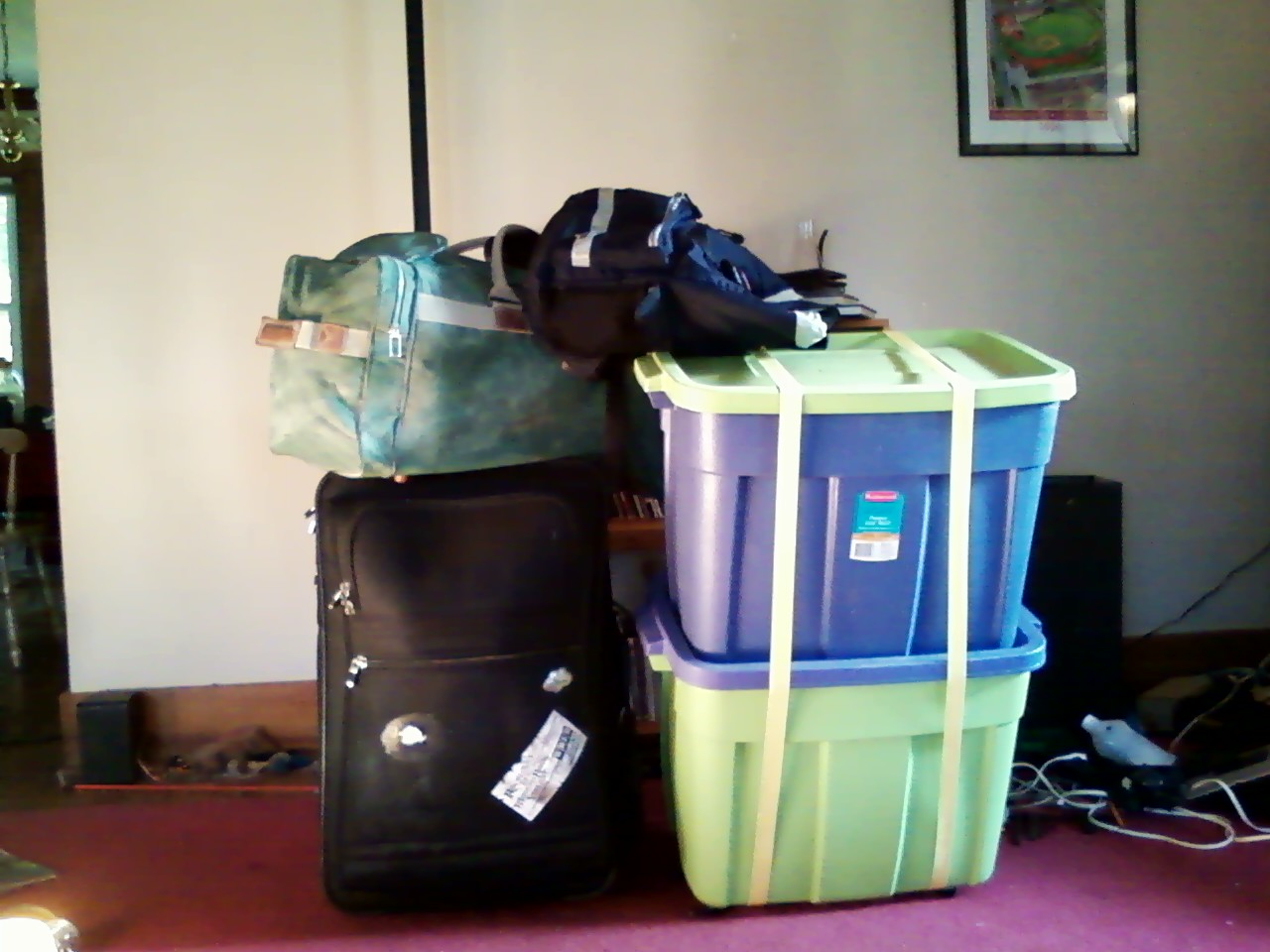
I had packed into two Rubbermaid totes, a large suitcase, a smaller bag, and a backpack. I made a custom cart to carry the totes along with the additional luggage tied on: the totes contained my to-be-filled water bottles, and the cart was to make it easier to navigate around Burning Man, particularly to get to a place to get a ride when I left. I was quite impressed as I ordinarily required the bulk of a car to carry everything I needed.

Two totes, a suitcase, a smaller bag, and a backpack

Everything I need for Burning Man 2011

Anyway, I figured I could check the large suitcase and two totes, and carry the backpack and smaller bag onto the train. I was told I couldn't check totes (a.k.a. harbinger number two) so I did some quick thinking and swapped the contents of the smaller bag with the equivalent volume from one of the totes. I checked the smaller bag and the large suitcase instead. (In the future I'll make canvas boxes for the totes with zippers and hide them inside, giving the illusion of "real" luggage.)

While waiting for the train (which was an hour and a half late from Albany no less — that's three) I met a guy who was trying to get to Cleveland. He didn't have much (if any) money but he was going to try and sweet-talk his way onto the train. I was quite sure it wouldn't work, at least not on such a busy route — if it had been quieter, he would have been able to board without a ticket beforehand then at least made it to Buffalo before being kicked off. I looked into just paying for his ticket but it was too expensive so I just gave him a few bucks to see if he could make it to Buffalo or beyond. He went to the ticket counter then disappeared. Then when I was boarding, he reappeared and tried to be my "porter". Alas, he was indeed denied entry to the train.

I finally boarded the westbound Amtrak Lakeshore Limited at 12:30 a.m. By 9 a.m. we were partway through Ohio.

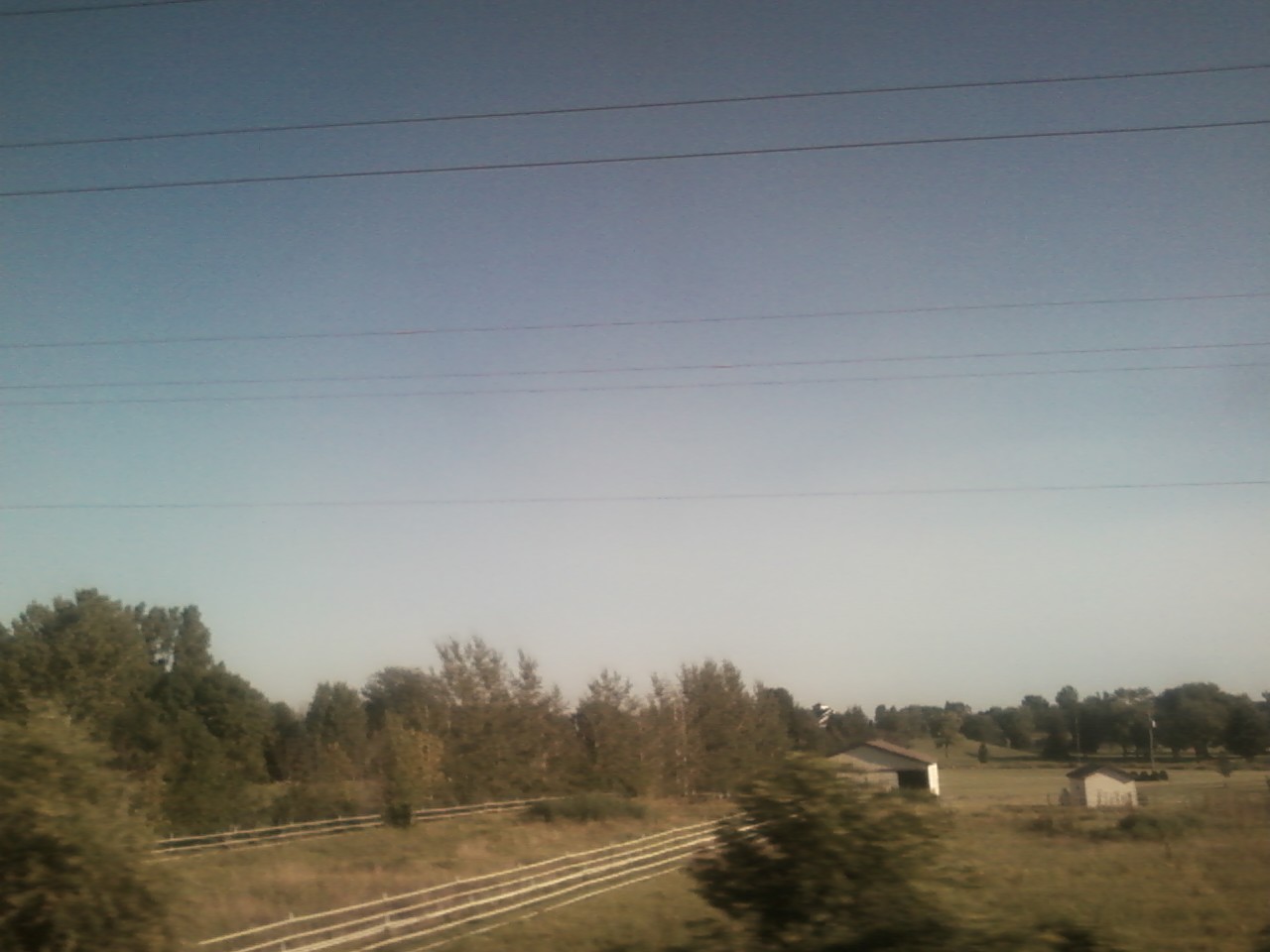
view from the Amtrak window just west of Bryan, Ohio

Just west of Bryan, Ohio from the Amtrak window

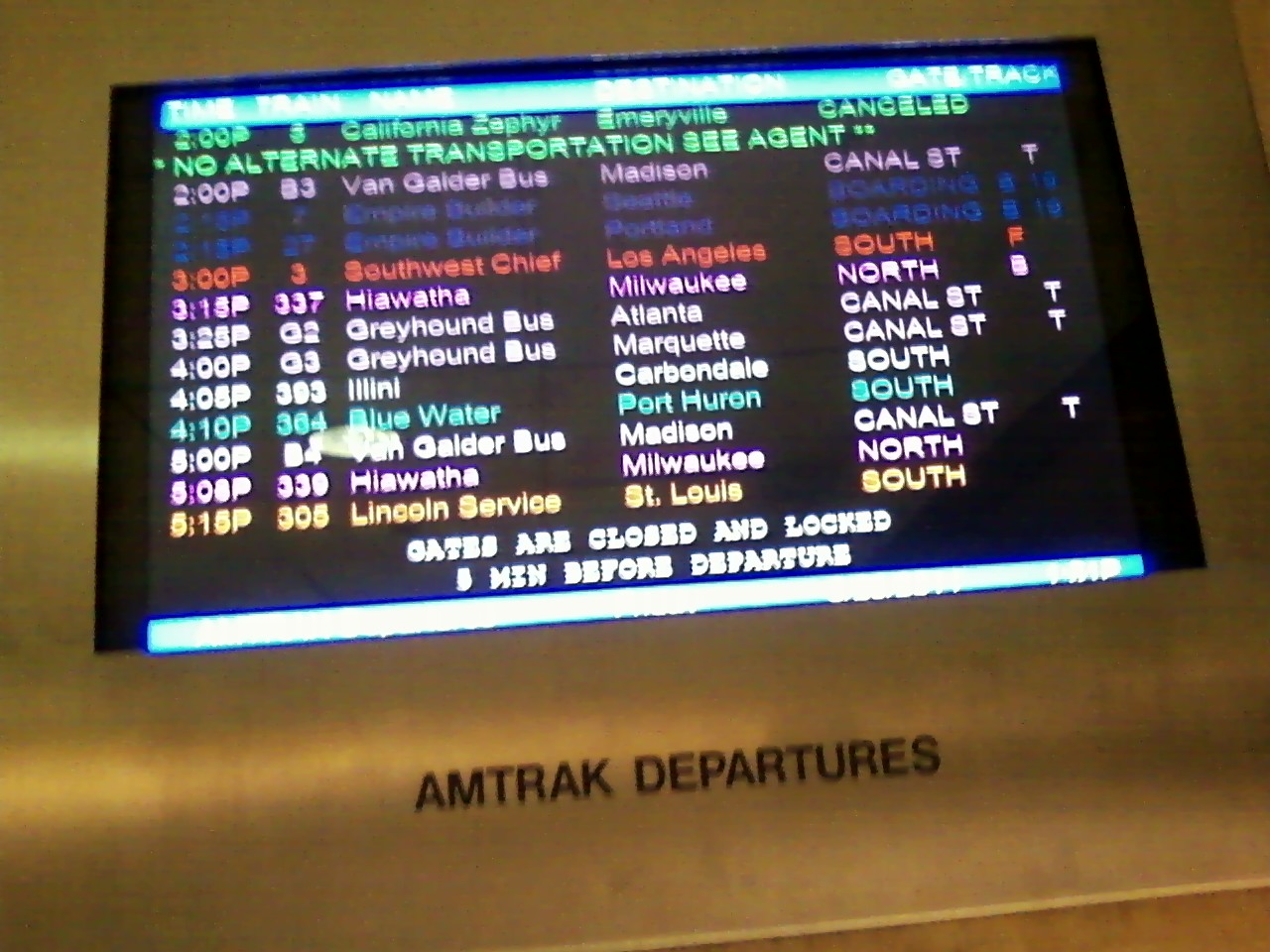
We arrived in Chicago a little late around 11:30 a.m. when I was confronted with this:

2:00P California Zephyr to Emeryville: CANCELED. * NO ALTERNATE TRANSPORTATION, SEE AGENT *

The moment I knew Burning Man was not-to-be this year.

My jaw dropped and my heart sank as I read — as if a personal message to me about my whole trip — "Cancelled. No alternative transportation". That was when I really surrendered. Momentum allowed me to continue to the long line at the ticket counter as there was a possibility of leaving a day later — perhaps an engine had failed and needed to be moved. Alas the worst: the eastbound California Zephyr struck a piece of construction equipment and derailed, injuring 22 people. Service was not expected to resume for several days at the earliest.

I was to meet some friends for a ride on Sunday to arrive on Monday when Burning Man started, so although I might have been able to figure out how to wait 24 hours, several days was out of the question (service was still disrupted as I write this, so at the earliest, I'd have left Sunday, arrived in Reno on Wednesday, then have to beg for a ride). Not to mention I couldn't afford to stay at a Chicago hotel for that amount of time, and it would disrupt my whole experience significantly. Cost prevented me from getting a rental car as well, and flying was not an option because of the amount of stuff I had with me. The mandatory American experience of taking a bus across the country will have to wait [for another lifetime].

So I exchanged my existing tickets and bought one to return to Rochester at 9:30 p.m. I also ran into two burners in the station (which I deduced from their fire-enhanced hula-hoops and fur-covered bikes). I didn't get their names, but asked what they were going to do. They opted to take the train to Portland, San Fransisco, and east to Reno, arriving a day and a half later. I probably could have done that, but like I said, I was getting a lot of signs to quit. I gave them my Burning Man ticket, and hopefully they could get it to someone who could use it (it might even help them get a ride).

I got a little into Chicago but had to tote the cart of totes around so I didn't get far. I went to Beggar's Pizza (310 S. Clinton St., Chicago, IL) which was excellent. The Chicago style was so good that if it wasn't textbook-perfect, they should rewrite the textbook.

For the remainder of the evening I hung around the station. I met a woman who came from Indiana to go to her brother's childhood friend's funeral in Iowa but she had to turn back too. And on "commiseration corner" of the fountain we also met a guy who went to boot camp for the Navy only to be rejected on a medical discharge and had to absorb the bittersweet experience of watching his campmates graduate in full dress uniform.

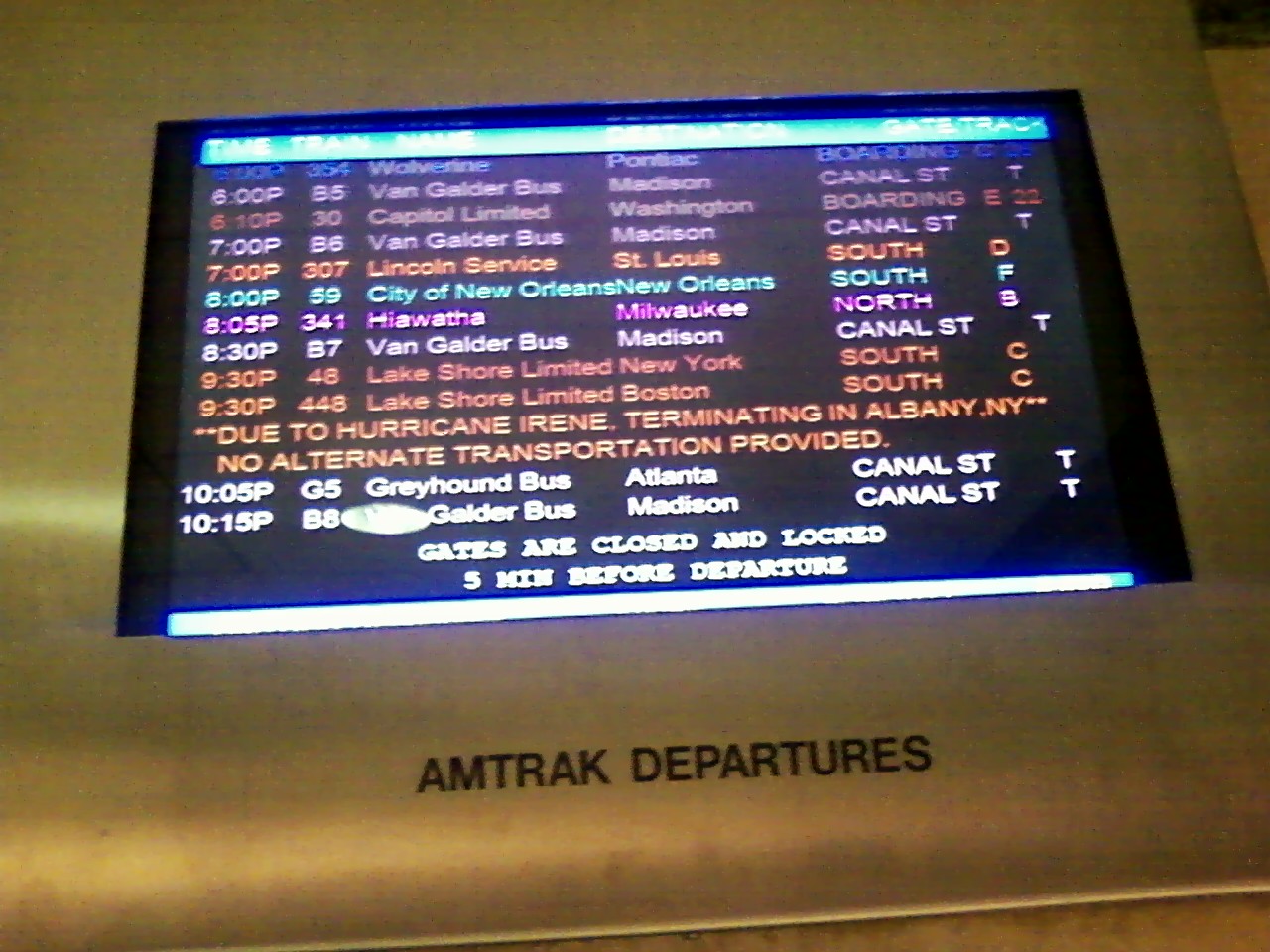
And even on the way home, things got complicated: Amtrak stopped service at Albany because of Hurricane Irene. Thankfully this didn't affect me because I only needed to get as far east as Rochester. As things had gone, I fully expected them to suddenly stop service at Buffalo, though.

9:30P 48/448 Lake Shore Limited to New York/Boston, **DUE TO HURRICANE IRENE, TERMINATING IN ALBANDY, NY** NO ALTERNATE TRANSPORTATION PROVIDED.

Thankfully I was only going to Rochester!

Obviously I'm really bummed. This was apparently the year of too-little, too-late. Earlier I had failed to get the Tadpole Trike finished on time. Then I hustled to get everything done to go by alternate means, but bigger and bigger roadblocks kept appearing. In both cases, I refer to a phenomenon I call "tractor-pull mode". In a modern tractor pull, a sled is used with weights over wheels that are slid forward causing the front to drag, so as Wikipedia puts it, "as the tractor travels the course, the weights are pushed forward of the sled's axles, pushing the front of the sled into the ground, synthetically creating a gain in weight until the tractor is no longer able to overcome the force of friction." Hence, the further I got, the more resistance I experienced.

At least I can look forward to the things I would have missed in Rochester. And I can look forward to FrostBurn and put some effort behind it. In any case, next year I will be much more committed. Or else I'll need to be committed.

Evening Wear at Burning Man

As you all know, I quit working on the tricycle I was planning to ride to Burning Man this year. Doing that meant my time was more-or-less free in the last two weeks, so I thought I'd dig into another project I wanted to do for a while now. A friend of mine gave me a fake-fur purple coat that just barely fits (thank goodness I've lost a few pounds!) My original plan included a heart-shaped light around where my heart is that would flash to my heartbeat, and then animate light tubes outward from there to cover the whole coat. I since switched to colored LED's which were more readily available and more reliable. I didn't bother trying to get the heart monitor working either (at least not yet), so it's all done with variable timing to give the illusion.

So first it was getting a way to make 50 color LED's light up like I wanted, then to make them show different colors, and finally, to animate them into patterns. Without too many disasters along the way, I got it all working.

Here's a link to a YouTube video that demonstrates what it can do. See you all soon!

Excuses, Excuses …

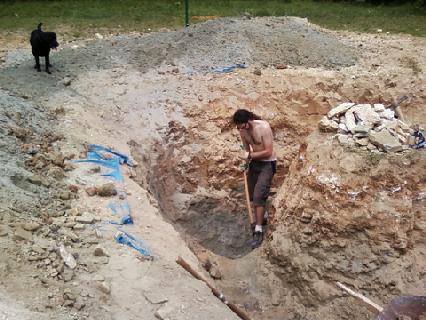
Wow: it's been quite a while — not since The Big Dig in July.

Anyway, the reason I've been away is this:

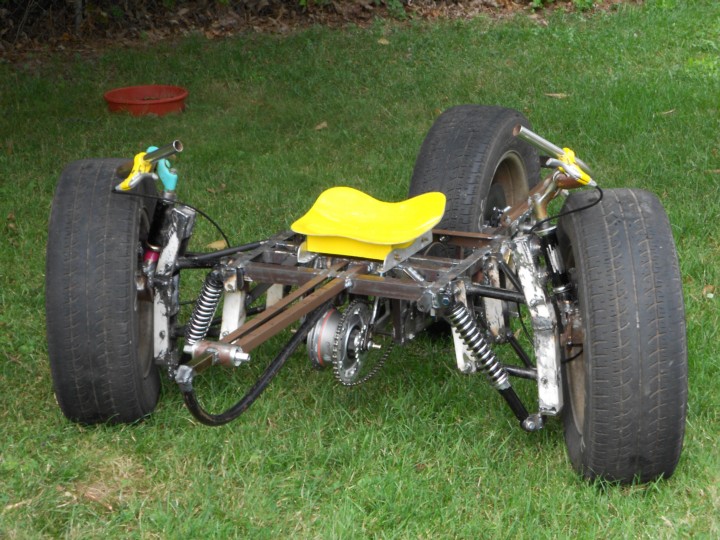
The Tadpole Trike, partially completed frame

What would have been the way to get to Burning Man this year ...

Sometime in early 2010, I hatched a plan to build a vehicle that I would transport to Winnemucca, Nevada then pedal 100 miles to Burning Man. I knew time was too short to make it for that year, so I slated it for 2011. Well, I spent hundreds of hours on design toward the beginning of the year, a dollar amount I'm afraid to calculate on custom-designed parts as well as off-the-shelf parts, and another hundreds-of-hours on building. By Sunday, August 7, I did not yet have a pedal-able vehicle, and I had 11 days before I would need to ship it, so I put it off for another year.

The more precise plan was to ship the trike to Winnemucca by UPS Ground. I have designed it so it folds up and can be shipped in a relatively small crate (which doubles as a trailer for extra gear). I would take the train to Winnemucca and it would hopefully be waiting at the hotel — probably Scott Shady Court Motel (400 1st St., Winnemucca, NV) which I stayed at and liked a lot before. Sunday, the day before Burning Man starts (on Monday), I'd get my water jugs filled, get packed up, and head for Jungo Road (a.k.a. Nevada SR 49). From there I'd pedal the 85 miles to 40° 46' 02.07" N, 119° 07' 12.26"W where there is a microwave antenna access road that crosses the railroad tracks. I would hope to pass the active mine at Sulphur before nightfall as there's a bit of traffic supporting it (not so much on Sunday, but on the way back). I'd take a right and cross the tracks then head due west across the Black Rock Desert, north of the Burning Man event, until I reach the barely-marked West Playa Highway which I'd take south to the main gate. After the event, I'd just reverse the trip. I estimate about 100 miles each way which could take anywhere from 10 to 24 hours depending on how fast I could go — and since I haven't tested anything yet, I really have no idea what is practical.

The vehicle itself is called a "tadpole trike" because it has three wheels and kind of looks like a tadpole with 2 wheels in front for steering and one rear wheel for propulsion. The picture shows the frame as far as I had completed it, and nearest the photographer is the mount for the pedals. I used parts from the 1994 Honda Civic I had taken off the road 2 years ago, parts from go-kart companies, bicycle parts, lots of scrap metal (mostly from bed frames), and the final drive is to use motorcycle chain for extra strength. I estimate that including the tires, it will weigh in slightly less than 200 pounds, so it's definitely not meant to win any hill-climbs.

But I did design it with a broad gearing range: a 2-speed custom shifter doubles the range of a continuous-variable Fallbrook NuVinci 360 internal hub shifter from a stump-pulling 0.2-to-1 to a mountain-bike-high-gear 3.5-to-1. In terms of gear-inches (which, if you imagine a pennyfarthing big-front-wheel bike, it's the effective diameter of that wheel) it has a range of 5.2 gear-inches to 18.2 gear-inches in low and 22.9 to 80.0 gear-inches in high. So with a pedaling speed range of 15 rpm to 150 rpm, that translates, overall, to 0.23 mph to 35 mph. And assuming I can put a maximum of 300 pounds of force on the pedal at a standstill, the lowest gearing will yield a massive 800 pounds of forward-force at the drive wheel.

I figure my goal is to just attempt it.  If I have to stop and go back, or haul the beast back broken, then so be it.  The road itself is generally pretty obvious, but I do have USGS topographic maps of the whole area along with a compass and a GPS for good measure.  I set up JayceLand to be able to accept picture-message posts like I did for the Big Dig … Verizon's map shows the last point of "coverage" to be around 40° 53' 21.534" N, 118° 26' 15.342" W which is little more than halfway, and not quite to Sulphur.

But alas, the whole idea seems to be quite distant now. Funny how a week ago I was picturing it actually happening, and now I don't even know if I'll try it in 2012 — or ever for that matter. I think I will desire it again in the future. After all, part of the beauty of it is that I can potentially be someplace where it's more than 20 miles to the nearest person. The whole trike and its testing is a separately interesting matter, but I can get that accomplished with some camping trips around here, or even just using it as a main vehicle.

We shall see!