Polite Company at the MuCCC

It's been a while since I went out to see improvisational comedy. I feel like I kind of burn out on it — after all, it can only be as good as the audience, the performers, and the circumstances. In addition, I tend to hang out with some pretty funny people so it's not uncommon for some extremely hilarious things to come out of it (for instance, I have brought up several times the idea of a Faustian superpower wish that goes awry when the power is revealed to be pooping delicious chocolate — and the comedy of failing to convince anyone that it is indeed true).

Anyway, I headed over to The Multi-Use Community Cultural Center (MuCCC) (142 Atlantic Ave.) to see the public debut of Polite Company Improv Sketch and Comedy. They were indeed funny both in their improv and in their sketches. I really appreciated that they catered to me being in their audience rather than targeting evangelical Puritans and forbidding swearing of any kind. (Seriously: the show doesn't need to stop if someone says "fuck" once.) Of note was their final sketch which was shockingly offensive, but ultimately quite funny.

Afterward I walked over to The Bamba Bistro (282 Alexander St.) for the after-party and got a chance to chat with the crew. (By the way, Bamba Bistro is a pretty upscale-looking place that draws people who like to be seen in upscale-looking places and, on this night, rowdy improvisers and their friends and fans. I'll add that friends raved about an astonishing meal here years ago and I assume that would continue to be true.) The two women running the troupe are engaging and focused — hopefully we'll see Polite Company shows for years to come.
The High Cost of Privatized Healthcare

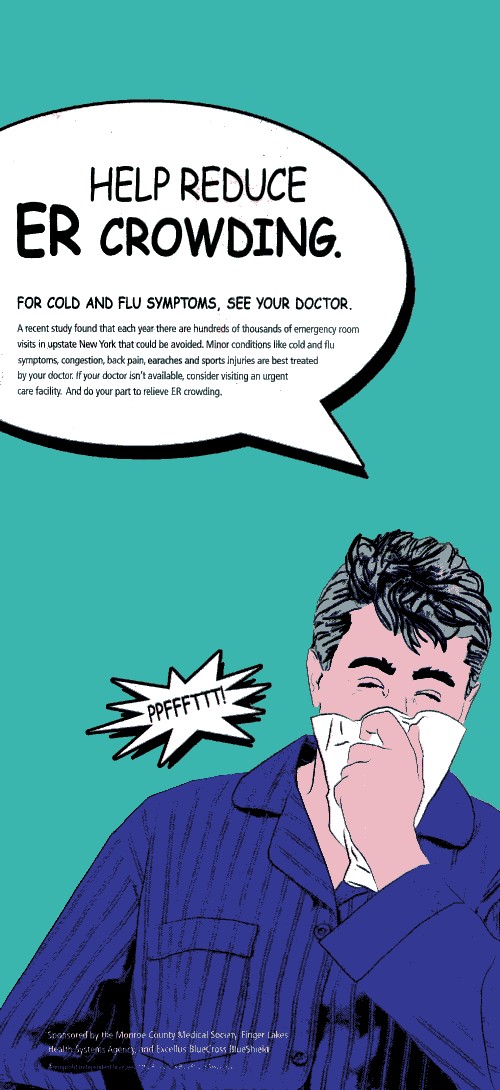
Advertisement encouraging people to see a doctor instead of going to the emergency room.

A "non-profit" sock-puppet of the private health insurance industry.

You may have seen these advertisements if, for instance, you have eyes and are have looked up outside. They are everywhere on billboards all around the city. According to the fine print (about 12 point on the full-page ad in the Brighton-Pittsford Post), they are "Sponsored by the Monroe County Medical Society, Finger Lakes Health Systems Agency, and Excellus BlueCross BlueShield" and then in even finer print (about 6 point), "A nonprofit independent licensee of the BlueCross BlueShield Association."

The Monroe County Medical Society is some kind of physician organization in the area. Their vague mission is to "unite to consider and act on matters affecting the practice of medicine, to extend medical knowledge and enlighten the public in the best interests of the health of the people of the county of Monroe." Likewise, The Finger Lakes Health Systems Agency "is an independent local organization working to improve health care in Rochester and the Finger Lakes region. We analyze the needs of the community, bring together organizations to solve health problems, and measure the results." And then there's Excellus BlueCross BlueShield, a corporation that sells health insurance and is the "nonprofit independent licensee of the BlueCross BlueShield Association." The BlueCross BlueShield Association is the nebulous parent organization whose function I don't understand as it relates to Excellus BlueCross BlueShield.

Anyway, all these shell games and misdirection align to provide what seems to be a concrete and simple statement: leave the emergency room for emergency services and see a physician at jeir office for non-emergency care.

But why would someone visit the E.R. if they could see a doctor? I know I wouldn't. However, I also know the secret answer: I only have a doctor because I became his patient while I had health insurance. If I did not have health insurance, I would have been refused. What I've found is that doctors generally do not accept patients who pay cash.

So I did a little bit of research on the glorious Internet. My question: do people in England head to the emergency room when they have a cold? After digging around a bit, I didn't find an answer either way. My supposition is, why would they? The E.R. is an unpleasant place, and if they could equally well go to a much more pleasant general practitioner's office, then I can only imagine they would. At least I would.

Thus, this "ER Crowding" problem is yet another cost of the profit-driven private health insurance industry in the United States. I find it appalling that funds that could have gone to serve nationalized health care were instead wasted on a huge advertising campaign.

The people want nationalized health care. The physicians want nationalized health care. The only ones who don't are the corporations of the health insurance industry and they own Congress.

Shame on you, members of The Monroe County Medical Society. Shame on you, Finger Lakes Health Systems Agency.

I Have a Dog Now

Last month I saw an ad for a dog to a good home. I replied and got the new dog, Lucy (Ali's and my dog), and Pumpkin Pie (my gray American short-hair cat, named by a crazy cat lady) all together and they seemed to get along acceptably — I know things would be rough, but the behavior of the new dog was key.

So last Monday the 23rd I got "Tieson" (the etymology of which I still haven't inquired about). He's a Jack Russell terrier who's 9-year-old (as of today, actually).

The first day I had him his behavior was better than I could have expected. Pumpkin was very patient and only a few skirmishes broke out. His previous owner said he had bladder issues when home alone, and I presumed it was due to separation anxiety. In fact, when I went to Genesee Bakery (1677 Mount Hope Ave.) for all of 10 minutes, he soaked a pillow pretty good. He only had one such "accident" so far.

That night, I let him sleep in my bed. During the night, I noticed he started to intensely regard the vacuum cleaner. After an hour or so, he decided that it was, indeed, an infernal machine and must be barked at. I turned on the light and he was startled to see me, transferring his agression to me. Before I could get him out of the bedroom, he managed to bite me pretty hard on the hand. Being kind of aggressive, I have learned this particular Jack Russell is happiest if he's kept in his place (e.g. lower than eye-contact with people.)

The next day went well as well. I learned some things he didn't like and mostly avoided them. However, when returning from a walk, I expected him to get bite-y when I toweled off his wet belly so I put on leather gloves and, when he inevitably did snap at me, I pinned him down firmly to show that I was "alpha". I didn't like doing it, but it didn't hurt him, and I had to do it again later when he snapped at me on my bed. I gather it's not harmful, per se, especially if used sparingly, but I don't want him to have an "alpha dog" relationship with me. It should help that I signed him up for obedience class at Dogs At Play (75 Howell St.)

By Thursday we were running together in the morning. Jack Russells are known for their speed and endurance: he kept up for all 4 miles or so. During the day, cat-dog relations had a setback when I picked up Pumpkin to pet him and Tieson, apparently jealous, seemed curious to see what I was doing and then he decided it was a good idea to bite Pumpkin's tail. I ended up with a couple scratches on my face and on my hands from the ensuing body launch.

Today he was thrilled to "go for a ride" and was even thrilled to visit the vet at Penfield Veterinary Hospital (1672 Penfield Rd.) for all his shots and more. Now he's all set for his dog license, so he gets to be a real little dog.

Truck Versus Man

I was walking out to go to The Bug JarMySpace link (219 Monroe Ave.) When I got to the end of my street, I saw a man walking in East Henrietta Rd. I thought nothing of it — after all, the sidewalks are covered in snow and ice, so depending on his physical condition and footwear, it's understandable that he would walk in the perfectly clear road. (I'm fortunate enough to have boots, balance, and strength, so I just get a tremendous workout in my gluteus maximus.) As I arrived at the intersection, I noticed the light was in my favor (even if the inconveniently-placed crosswalk doesn't reflect that) so I was making my way across, parallel to the light traffic. As the light started changing and the last vehicle passed, I heard a thud, as if the pick-up truck had run over a log in the road.

I knew it was trouble before I turned around, and as I had expected, the man was lying in the road.

I was calling 911 (although I almost called 9111 in my panic) before the driver even got out of the truck. I think my initial assumption was incorrect — the man wasn't run over, but run into. Thankfully the driver was going relatively slowly, but he didn't see the man and didn't react, so the truck hit with full force. A firetruck, ambulance, and two police cars arrived within a couple minutes. They got the man on a backboard and into the ambulance — he didn't appear to have a broken back or other severe injury, so I hope the worst he could suffer would be a broken bone or two.

I always wonder how most people think this is okay — as if it's just a fact of life that these kinds of car accidents happen. It was certainly preventable. Why aren't cars equipped with brakes that engage automatically when they detect something? For that matter, why aren't the sidewalks cleared to the same standard as the street? I could blame the driver, but humans are wholly unequipped to drive the same route without incident and be expected to handle a random, unusual circumstance, proven again and again by psychology and anthropology.

It's really too bad we can't use science to guide our collective decision-making.

Tuesday, After Christmas, at the Dryden

I cannot stop being mildly amused that I headed out on the Tuesday after Christmas to see Marti, dupa craciun (Tuesday, After Christmas) at the Dryden Theater at George Eastman House (900 East Ave.) — clearly a little film programming joke from Lori Donnelly.

In the film, Paul is married to Adriana and together they have a child, but Paul is also involved in a long-term relationship with the girl's dentist, Raluca. There is no doubt how the story will play out: the relationship with Raluca will replace Paul's relationship with Adriana, and the film takes careful, deliberate steps to let us watch this unfold. As the Eastman House calendar so eloquently put it, the film captures "its trio of lived-in performances with graceful, uninterrupted long takes and a knowing sense of the human comedy."

As I watched with from my odd personal vantage point, I couldn't help but think, "it's such a shame they want it to go so badly — they really believe that anything but unwavering, complete monogamy is a fatal, destructive flaw."

Instead, what if the central couple understood that all of one's needs — intellectual, emotional, sexual, support, etc. — simply cannot be met adequately by one other person forever. Keep the core of devotion, but allow for needs and desires to be negotiated. If Adriana knew that Paul was sexually and emotionally in need, and she did not want to (or could not) fulfill those needs herself, why not let Paul fulfill them elsewhere? I'm sure likewise that Paul did not meet every one of Adriana's needs, so she too could be free to find fulfillment some other way. Why let it build from a mild hunger to desperate starvation when a tiny morsel at the outset would do just as well?

What we call a "normal healthy relationship" sure is weird to me.

Getting Back to Emerging Filmmakers at the Little

It's been a long time, but I got a note about The Emerging Filmmakers Series at The Little (240 East Ave.) so I decided to go check it out.

Starting out was With Love, Marty by Jack Kyser in which Kyser plays the central character: a college-age man desperate for the affection of a specific woman. I found his presentation to be brutally honest from all angles — I know from experience how it is to desperately desire someone, and to resort to honest, direct means that work only to sabotage any possible relationship. It touches on the way you can fool yourself into thinking the mental picture you have of someone is the true picture of jem (when, in fact, all representations of other people in your mind are simply reflections of yourself — they are, ultimately, you.)

61 Years by Holly Rodricks is a documentary about her grandmother and grandfather's tumultuous relationship at the end of his life. It was a beautiful and moving piece about life and death, wishes and realities. It starts out with Rodrick's grandmother insisting that her grandfather has been punishing her for her entire life for marrying against their parents wishes (they are Indian, and got married in defiance of their destined, prearranged marriage). Meanwhile, her grandfather is quietly dying — the fragile shell of a once brash and bold man. But under all the outward complaints, and aside from the dutiful commitment to one another, lies real compassion and tenderness.

The Breakfast by Tanya Schiller was a curious, subtly humorous piece that simply followed the interactions of four people eating breakfast at a bed-and-breakfast.

Closing out was American Bomber: The John William Hidell Story by Eric Trenkamp. It's a faux-documentary about the "first American suicide bomber" — it uses the talking-heads model of documentary making to create a story about a man who lashes out — literally self-destructively — at those he feels are a threat. It works nearly perfectly with only a few minor problems that tip off that it can't possibly be for real. But interestingly, in being so near perfect, what would it take to make a perfect fake documentary?

Watching Martha Marcy May Marlene and Margin Call at the Cinema

I missed out on Martha Marcy May Marlene when it screened at The Little (240 East Ave.) a few weeks back, but I got a chance to see it at The Cinema TheatreMySpace link (957 South Clinton Ave.) as part of a double-feature with Margin Call.

I'll start with Margin Call and say just a little: it's the story of the 2008 financial meltdown convincingly told with a sympathetic eye to the people closest to the problem. It really only served to reinforce my opinion that the stock market is nothing more than gambling with no relevance to any real value in the world. It was good, solid entertainment.

Martha Marcy May Marlene plays out largely in flashback: the tale of a woman indoctrinated into a rural cult. I think most people watch the film as a sort of horror/thriller, exposing the layers of lies, power, and brainwashing that get an otherwise reasonable person to embrace completely absurd notions. But I guess I come from a weird perspective, and saw it as a tale that compares two cults: one at a rural farm, and the other, American industrialized society. When Martha (a.k.a. Marcy May as named by the cult leaders, or Marlene when any of the women answered the phone) is reacquainted with her sister Lucy, she returns to Lucy and her husband Ted's summer home (none of who utters reference to a "cult" as none either knows or believes it). She first showers and when she rejoins Lucy on a bed, Lucy says, "oh, you're dripping", referring to Martha's wet hair. Particularly given the more important things going on, why is this even remotely important?: it is the Lucy/Ted/American culture's set of arbitrary and irrelevant rules.

Like Kynodontas (Dogtooth) (which I saw at the Dryden), the film acts as a mirror to our own society. My culture's foundation is violence: if I don't do what I'm supposed to do, society responds with force (which may sound familiar, taken from Derrick Jensen's philosophy). For instance, if I decide that the house I have been living in (exclusively, for the last 12 years, and no other person has come by to claim it is theirs) is mine and I decide to no longer pay my mortgage, eventually someone will come with a gun and tell me I have to leave. That is the incentive for paying my mortgage. Of course, it's conditioned from an early age, so it doesn't seem like that's the reason, but it ultimately is.

I of course know the differences between my culture and the cult, but the lines were pretty severely blurred by the end of the film. It's kind of a "choose your own poison" kind of tale. Martha is a pawn in the game where she's either enslaved to pay for her existence, or, well, enslaved to pay for her existence. There's happiness and misery to be found in both places only at different times and in different forms. But ultimately she's asking the right questions: why do I have to?

Heading to the Cinema for The Big Year and Real Steel

I ran a few errands early and wanted to go out late, leaving a big window of time. I stopped by The Cinema TheatreMySpace link (957 South Clinton Ave.) to see what was playing: The Big Year, and Real Steel. I had very low expectations about both films, but once in a while I like to make sure my off-the-cuff assessments agree with reality. I see a lot of intellectual movies, and seek out movies for cinephiles; I'll watch an otherwise boring movie if it has one exceptional element — great cinematography or something. But seldom do I go out for some mainstream popular film.

The Big Year stars Jack Black, Owen Wilson, and Steve Martin. Each are trying for a "big year" — quoting the Wikipedia article, "an informal competition among birders to see who can see or hear the largest number of species of birds within a single calendar year and within a specific geographical area." The movie gets off to a poor start in my book with Black as Brad, a nuclear power-plant computer operator who provides expository voiceover to explain the movie. then we're introduced to Wilson as Bostick, the "reigning champion", and finally Martin as Stu who is trying to retire as CEO of a big company.

After the formulaic character introductions are established, the movie gets rolling to various attractive locales with a modestly good songs to go with it. Naturally each has a love interest. Stu gets the most realistically loving wife in JoBeth Williams. Bostick is also married, his wife played by Rosamund Pike who he treats like crap but she's too dumb to be anything but loyal for the sake of the story. Brad finds a love interest in Ellie played by Rashida Jones. (I found her super cute and could easily develop a fanboy crush.) The film blunders along with the species-count challenge fueling its underpowered engine until it finishes with a tidy, heartwarming ending. The movie was sufficiently weak that I found a highlight in a brief few scenes with Jim Parsons who plays Sheldon on The Big Bang Theory.

In all it's not atrocious as films go. I think it could be saved for a film nut like me by skipping the first 25 minutes or so: skip all the character introductions and exposition and jump right into the contest. It quickly becomes clear who's who and what's what, and I think it would make a better movie to figure it all out along the way.

Next was Real Steel which had pretty cool and seamlessly-integrated special effects. The setting is a few decades in the future where remote-controlled boxing robots are all the rage.  Hugh Jackman plays Charlie who likes to throw away money he doesn't have on junky fighting robots, only to have them thoroughly destroyed. He blankly reacts to the death of his ex-girlfriend as a vehicle to introduce his 11-year-old son Max (Dakota Goyo). A wealthy aunt and uncle are ready to adopt Max, but naturally Charlie gets to take him for a while and brings the kid into the world of robot boxing. It's a Disney kids movie so its plot is absent of surprises for adults as everything that is about to happen it tweeted half an hour in advance.

I find it surprising that people continue to flock to Disney movies like this. Charlie is a terrible guy, and a worse father. He's a drunk, introduced in his cargo truck stumbling over beer bottles (although for the sake of the kids movie he never acts drunk, drinks much, nor does anybody smoke). He steals money from a guy who is later tagged a "bad guy" for tracking him down and beating him a bit to get it back. He drags the kid through all kinds of life-threatening danger. He extorts the aunt and uncle for money by pretending to want to adopt Max in court. And he's abusive to his love-interest Bailey (Evangeline Lilly) — who naturally stays loyal (pay attention, girls, Disney is speaking to you!)

The best I can say about the movie is, "it's kind of cool looking". The computer graphics animation is always completely seamless, giving the illusion of these big robots being present. But that's pretty much it.

I'm trying to remember anything from Real Steel that made me want to care about the movie or any of the characters. The Big Year at least had a few sweet moments in it, and it's probably redeemable by skipping a bit. I may contemplate an alternative home-movie screening where I pick movies that may be salvageable in that manner — perhaps a shortened double-feature night … hmm …

Watching Melancholia at the Little

I headed out to The Little (240 East Ave.) because I wanted to see either Melancholia or Take Shelter. A guy I know who works there suggested Melancholia since it would be shown less next week and probably close sooner than Take Shelter, so I did. It's directed by Lars von Trier and, although I'm kind of a film nut, a little research reveals this is probably the first film of his that I've actually seen.

Central to the story — at least in a way — is the newly discovered planet Melancholia which is introduced in a stylistic opening scene destroying the Earth. Then we rewind a while to find Justine about to be married to Michael which doesn't go all that well. In the second part, we focus on Justine's sister Claire and the fallout from the wedding disaster. Oh, and by now we're approaching the film's introduction — although none of the characters have any certainty whether Melancholia will hit the earth or not.

On the whole, the film drenches the audience in melancholy, qua depression. As someone who navigates those waters often enough, it was a familiar sight for sure. I'm reminded of a time when some friends and I decided to go to a "depression screening" at UofR. We each took a self-assessment then talked with some medical students who assessed our situation. Naturally we were all recommended for professional help (not surprising, as we're all artist/creative-types). My one friend told his student doctor something like, "I kind of like the bitter edge it gives life." I tend to agree: although things get pretty dark sometimes, it certainly gives me a different perspective on things.

Likewise for Justine who spends her last hours in a strange state of unhappy blissful confidence that indeed all things will end. It's a state that only the depressed truly know, and I guess it's kind of the pot-of-steel at the end of a desaturated rainbow.

So I found Melancholia to be peculiarly familiar. It was quickly apparent to me to just soak in it and let it soak in. And although I wasn't depressed at the time, I got a chance to see it from yet another angle.

The Eastman House Cafe's Anti-Local Habit

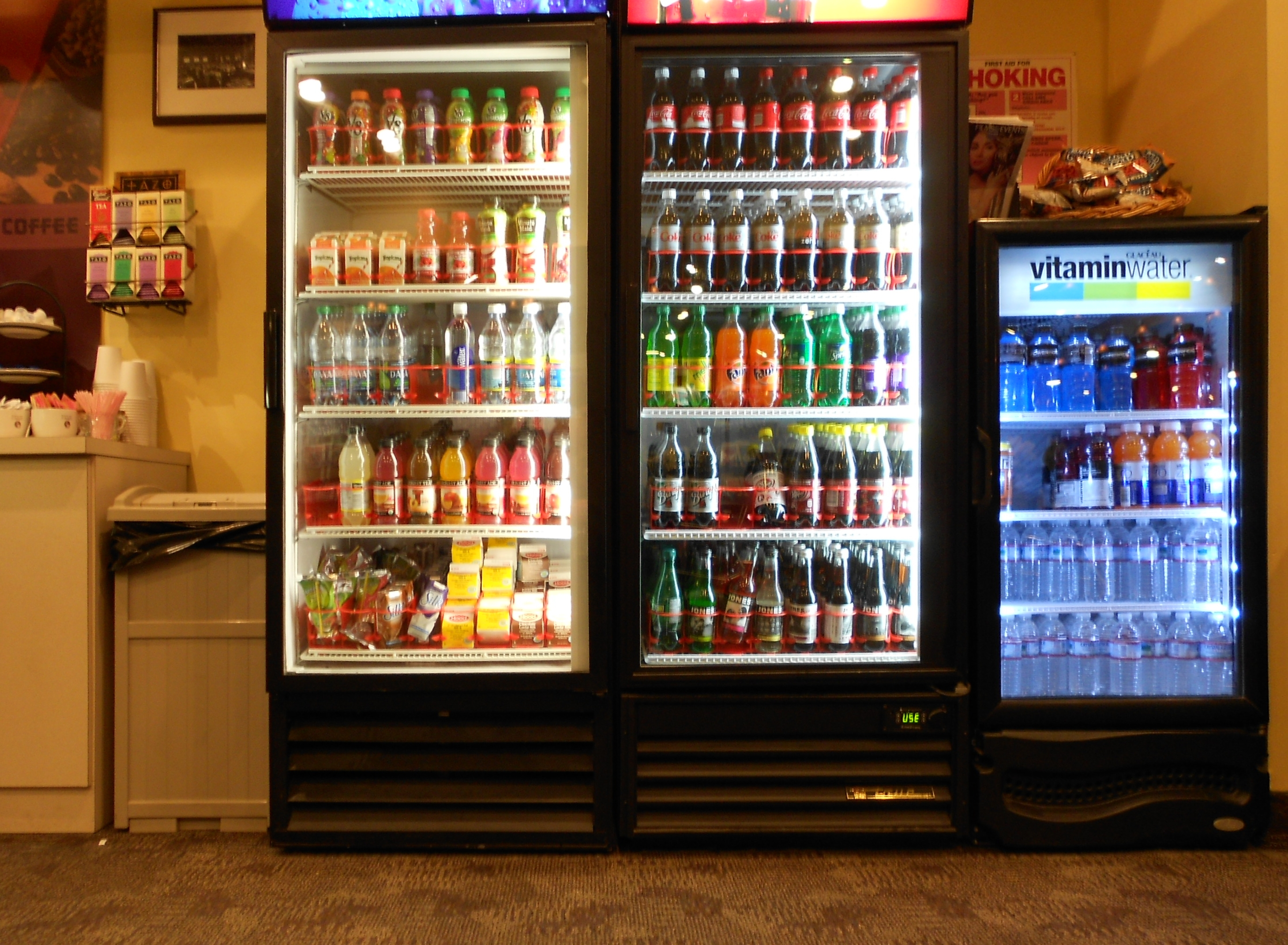
Eastman House Cafe's Coolers in December, 2011

Eastman House Cafe's Coolers in December, 2011

About a year ago I complained to the George Eastman House (900 East Ave.) about the coffee in their cafe. I noticed the cafe had replaced the fair-traded coffee from The Coffee Connection (681 South Ave., formerly the Women's Coffee Connection) with Eight O'Clock Coffee. More generally, the cafe had been replacing (and continues to replace) locally-sourced products with non-local ones. In a letter from Commercial Development Director Peter Briggs, he said that the Eight O'Clock Coffee was replacing Paul DeLima coffee, not the fair-traded coffee from Coffee Connection. He added that he was pleased to note that nearly all the checks sent out go to Rochester addresses. Poor proof indeed: my RG&E check goes to East Avenue, but that doesn't mean that it's local [hint: follow Carmen Sandiego to Spain].

Well, now it's come to pass that all that's available at the cafe is Eight O'Clock Coffee (unless you specifically ask for them to brew a pot of fair-trade just for you) [and I have not yet mentioned how flagrantly inferior Eight O'Clock is to locally-roasted beans, but that's another topic]. I've also noticed that the cooler — pictured above — is also sparse of local products. If you can't see close enough, the products and their manufacturers are:

  • Minute Maid, Dasani, SmartWater, Coke, Mello Yello, Fanta, Sprite, Barq's, Dr. Pepper, Power Ade, Vitamin Water: Coca-Cola Company, Atlanta, GA
  • V8: Campbell Soup Company, Camden, NJ
  • Tropicana: PepsiCo, Inc. (Purchase, NY, NYC area), Chicago, IL
  • Red Jacket Orchard: Geneva, NY
  • Honest Tea, Honest Ade: 40% Coca-Cola, Bethesda, MD
  • Silk: White Wave Foods, Dallas, TX
  • Hood: HP Hood, LLC, Lynnfield, MA
  • Perier: Nestlé Corporation, Vevey, Switzerland
  • Jones: Jones Soda Co., Seattle, WA
  • Crystal Geyser water: CG Roxane — of mysterious sources around California

Thus, there actually is what I'd qualify a "local product" tucked in there: Red Jacket Orchards from Geneva. But why no milk from Pittsford Farms Dairy, or even Byrne Dairy (from Syracuse), or even Upstate Farms? Why no soft drinks from Saranac (F.X. Matt Brewing Company in Utica)? Why no cider from Schutt's Cider Mill? And expanding to the rest of the cafe: why no snacks from Stever's, Hedonist, or the Nut House (two-of-three of which are available at the Little). At least the gelato is locally sourced and the cookies are baked on-site.

In my mind, the Eastman House has equal responsibility to support its community as its community does to support it. Given George Eastman's contributions to this city, it's apparent he was proud of it, and I can only assume he had an interest in supporting it.